How to Write Amazon Bullet Points That Convert: A Data-Driven Guide
Learn the science behind high-converting Amazon bullet points. From benefit-first formatting to readability scoring, this guide shows you how to write bullets that turn browsers into buyers.
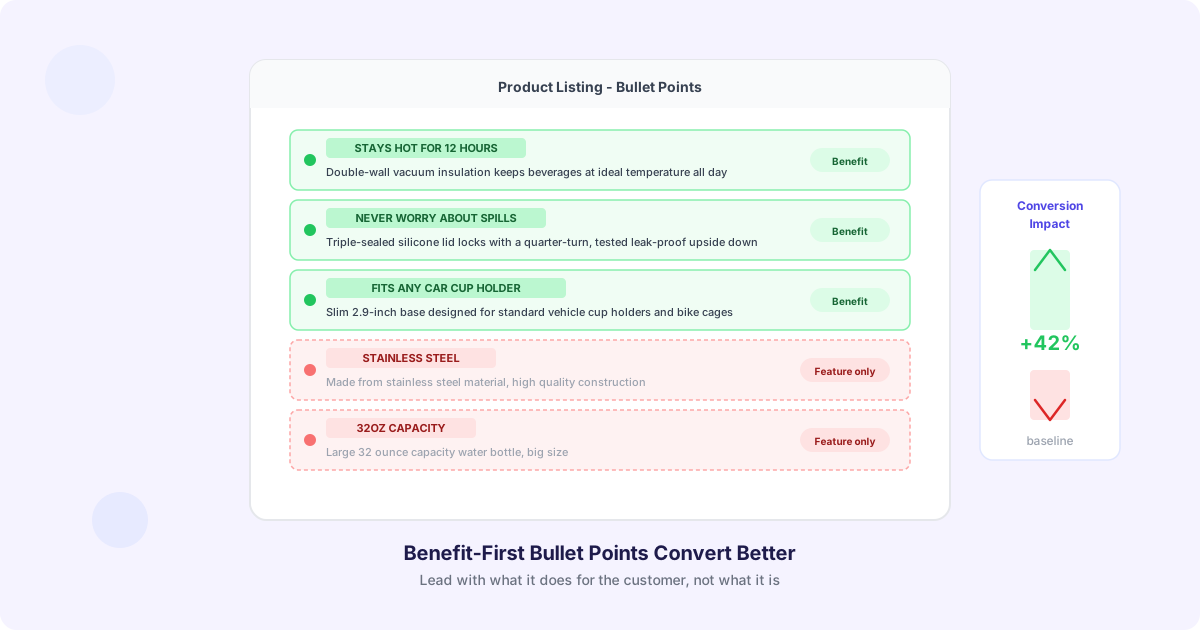
Amazon gives you five bullet points to convince a shopper to buy your product. That is five chances to answer their questions, address their concerns, and demonstrate why your product is worth the price. Most sellers waste those chances by listing features without explaining why they matter.
The difference between a listing that converts at 8% and one that converts at 15% often comes down to how bullet points are written. Not what they say, but how they frame it. In this guide, we break down the anatomy of high-converting bullet points using data from thousands of analyzed listings, and give you a practical framework for writing bullets that turn browsers into buyers.
Why Bullet Points Are the Highest-Leverage Content
Shoppers scan Amazon listings in a predictable pattern. Eye-tracking studies and behavioral data reveal that after the product image and title, bullet points receive the most attention on a product detail page. Most shoppers decide whether to scroll down to the full description or add to cart based on what they read in the first three bullet points.
Here is why bullet points carry disproportionate weight:
- Mobile-first viewing: On mobile (over 60% of Amazon traffic), bullet points appear prominently above the fold. The full description requires scrolling.
- Scanning behavior: Shoppers scan bullet points looking for specific answers. They rarely read every word — they look for keywords and phrases that match their needs.
- Decision shortcuts: Each bullet point is an opportunity to eliminate a reason NOT to buy. “Is it dishwasher safe?” Check. “Does it fit in my car?” Check. Five cleared objections can drive a purchase.
- AI evaluation: Amazon’s Rufus AI shopping assistant heavily evaluates bullet points when answering shopper questions. Bullets that directly answer common questions are more likely to be quoted by Rufus.
The Anatomy of a High-Converting Bullet Point
After analyzing listings across dozens of categories, a consistent pattern emerges in the highest-converting bullet points. They follow a three-part structure:
1. Benefit Lead-In (ALL CAPS)
The first few words of each bullet point should state the primary benefit in capitalized text. This creates a scannable heading that shoppers can quickly evaluate.
Examples:
- STAYS HOT FOR 12 HOURS —
- NEVER WORRY ABOUT SPILLS —
- FITS IN ANY CAR CUP HOLDER —
- SAFE FOR YOUR WHOLE FAMILY —
The ALL CAPS portion acts as a headline for the bullet. Shoppers scanning the page read these first, and if one catches their attention, they read the rest of that bullet.
2. Feature-to-Benefit Bridge
After the lead-in, connect the specific product feature to the benefit with concrete details. This is where you provide the evidence that supports your benefit claim.
Examples:
- STAYS HOT FOR 12 HOURS — Double-wall vacuum insulation with a copper lining keeps your morning coffee at the perfect drinking temperature from your commute through your afternoon meeting.
- NEVER WORRY ABOUT SPILLS — The triple-sealed silicone lid locks tight with a quarter-turn and has been tested leak-proof even when carried upside down in a gym bag.
Notice the pattern: the benefit hooks them, the feature-to-benefit bridge convinces them. The feature alone (“double-wall vacuum insulation”) would not motivate a purchase. But framed as “keeps your morning coffee at the perfect drinking temperature from your commute through your afternoon meeting,” it becomes a tangible benefit they can envision.
3. Use-Case or Scenario Anchor
End each bullet point with a real-world scenario that helps the shopper envision using the product. This activates what psychologists call “mental simulation” — the shopper imagines themselves using the product, which increases purchase intent.
Example of the complete pattern:
FITS IN ANY CAR CUP HOLDER — The slim 2.9-inch base slides into standard vehicle cup holders, bike bottle cages, and backpack side pockets, making it the perfect companion for your daily commute, weekend trail rides, or cross-country road trips.
This bullet works because it:
- Leads with a benefit the shopper cares about (fit/compatibility)
- Provides specific evidence (2.9-inch base, standard holders)
- Anchors to real scenarios (commute, trail rides, road trips)
Optimal Bullet Point Length
How long should each bullet point be? The data suggests a clear sweet spot:
The 150-250 Character Range
Bullet points shorter than 150 characters tend to be too sparse — they state a feature without enough context to be persuasive. Bullet points longer than 300 characters lose the scanning advantage — shoppers skip past walls of text.
The optimal range is 150-250 characters per bullet point. Within this range, you have enough space for the benefit lead-in, feature bridge, and scenario anchor without overwhelming the reader.
Character Count by Category
Different categories have slightly different optimal lengths:
| Category | Optimal Bullet Length | Why |
|---|---|---|
| Electronics | 200-250 characters | Technical details need more space |
| Kitchen/Home | 150-200 characters | Use cases are intuitive, less explanation needed |
| Health/Beauty | 180-220 characters | Ingredients and claims need context |
| Clothing | 120-180 characters | Fabric/fit details are short, scenarios are visual |
| Toys/Games | 150-200 characters | Age ranges and safety details are important |
Mobile Readability
On mobile devices, long bullet points wrap to multiple lines and become difficult to scan. Test your bullet points by viewing your listing on a phone. If any bullet wraps to more than 3 lines on mobile, consider shortening it.
Readability: Write for a Grade 8-10 Level
Amazon shoppers are not reading academic papers. They are making quick purchase decisions, often on their phone, often distracted. Your bullet points need to be instantly comprehensible.
What Grade 8-10 Reading Level Means
A Grade 8-10 reading level (Flesch-Kincaid scale) means:
- Sentences average 15-20 words
- Words are mostly 1-2 syllables
- No jargon unless category-specific and well-known
- Ideas are expressed directly, not through complex subordinate clauses
Before and After: Readability Improvement
Before (Grade 14 — too complex):
Manufactured utilizing proprietary double-wall vacuum insulation technology with an additional copper thermal barrier, this vessel maintains the temperature of heated beverages for a duration not to exceed twelve hours under standard environmental conditions.
After (Grade 8 — clear and persuasive):
STAYS HOT FOR 12 HOURS — Double-wall vacuum insulation with a copper lining keeps your coffee at the perfect temperature all day long, from your morning commute to your afternoon meeting.
Both convey the same information. The second version is shorter, clearer, and more persuasive because it connects the feature to the shopper’s experience.
Words to Avoid
Some words signal complex writing and reduce comprehension speed:
- “Utilize” — say “use” instead
- “Approximately” — say “about” instead
- “Functionality” — say “feature” or describe what it does
- “Furthermore” / “Moreover” — just start the next sentence
- “Proprietary” — say “our” or “custom-designed”
Keep your language conversational and specific. If a word has a simpler synonym that means the same thing, use the simpler word.
The Five-Bullet Strategy: What Each Bullet Should Cover
You have five bullet points. Each one should serve a distinct purpose. Here is a proven allocation strategy:
Bullet 1: Primary Benefit (Your Strongest Selling Point)
Your first bullet gets the most attention. Lead with the single most compelling reason to buy your product. This should address the primary purchase driver for your category.
For a water bottle: Temperature retention (the main reason people buy insulated bottles) For a phone case: Protection level (the main reason people buy cases) For a kitchen knife: Cutting performance (the main reason people buy knives)
Bullet 2: Unique Differentiator
What makes your product different from the other 50 options in the search results? Your second bullet should highlight what sets you apart — ideally something competitors cannot easily claim.
Examples of strong differentiators:
- Patented technology or design
- Specific certifications (FDA, CE, UL)
- Unique materials or manufacturing
- Performance metrics that exceed the category average
Bullet 3: Convenience or Ease of Use
Address how easy the product is to use, maintain, or integrate into the shopper’s life. Convenience sells because it reduces the perceived effort of ownership.
Common convenience angles:
- Easy to clean (dishwasher safe, removable parts)
- Easy to use (one-handed operation, intuitive controls)
- Easy to store (collapsible, compact, stackable)
- Easy to set up (no tools required, pre-assembled)
Bullet 4: Compatibility, Sizing, or Specifications
Answer the practical questions that cause shoppers to hesitate. Will it fit? Is it compatible? What are the exact dimensions? Eliminating uncertainty removes friction from the purchase decision.
What to include:
- Exact dimensions and weight
- Compatibility with specific devices, vehicles, or standards
- Available sizes, colors, or configurations
- Package contents (what is included and what is not)
Bullet 5: Trust and Risk Reduction
Your final bullet should reduce perceived purchase risk. This is where you address the shopper’s fear of making the wrong choice.
Trust-building elements:
- Warranty or guarantee information
- Customer service commitment
- Satisfaction guarantee or return policy emphasis
- Certifications, testing results, or compliance statements
- Social proof hints (“Trusted by over 50,000 customers”)
Using Bullet Points to Answer Rufus Questions
Amazon’s Rufus AI assistant directly reads and evaluates your bullet points when answering shopper questions. This is one of the most important developments in Amazon listing optimization, and it changes how you should approach bullet point content.
When a shopper asks Rufus “Is this water bottle dishwasher safe?”, Rufus scans your listing for the answer. If your bullet point says “EASY TO CLEAN — Top-rack dishwasher safe, or hand wash with warm soapy water in seconds,” Rufus can confidently answer the question and recommend your product.
How to Optimize Bullets for Rufus
-
Identify the top 10 questions shoppers ask in your category. Check the “Customer Questions & Answers” section of the top 5 competing listings. The same questions come up repeatedly.
-
Embed answers directly in your bullet points. Do not make Rufus infer — state the answer explicitly.
-
Use natural, quotable language. Write sentences that Rufus could directly quote in response to a question. “Dishwasher safe on the top rack” is quotable. “Cleaning facilitation achieved through automated appliance compatibility” is not.
-
Cover comparison questions. Shoppers ask “How does this compare to X?” Bullets that provide specific, quantifiable claims (numbers, certifications, measurable performance) give Rufus material for comparison responses.
For a deeper understanding of how Amazon’s AI evaluates your listing content, read our guide on how CoSMo scoring works.
A/B Testing Your Bullet Points
Writing great bullet points is step one. Testing them is step two. Amazon offers a built-in A/B testing tool called “Manage Your Experiments” (available to brand-registered sellers) that lets you test different bullet point versions against each other.
What to Test
- Benefit lead-in phrasing: Does “STAYS HOT FOR 12 HOURS” outperform “ALL-DAY TEMPERATURE RETENTION”?
- Bullet order: Does leading with your differentiator outperform leading with your primary benefit?
- Length: Do shorter, punchier bullets convert better than detailed, comprehensive ones in your category?
- Specificity level: Do exact numbers (“2.9-inch base”) outperform general claims (“fits most cup holders”)?
Testing Rules
- Test one variable at a time. If you change all five bullets simultaneously, you cannot attribute any improvement to a specific change.
- Run tests for at least 4 weeks to account for daily and weekly variation.
- Need at least 100 conversions per variation for statistical significance.
- Document results and apply winners across similar listings in your catalog.
Common Bullet Point Mistakes
Mistake 1: Feature Dumping
Bad: “Stainless steel, double-wall, vacuum insulated, BPA free, leak proof, 32oz capacity”
This is a feature list, not a bullet point. Each feature is stated without context. The shopper has to do the mental work of figuring out why these features matter. Most will not bother.
Better: “KEEPS DRINKS AT THE PERFECT TEMPERATURE — 304 food-grade stainless steel with double-wall vacuum insulation keeps your coffee hot for 12 hours or your water ice-cold for 24 hours.”
Mistake 2: Keyword Stuffing
Bad: “Water bottle insulated water bottle stainless steel water bottle vacuum insulated water bottle 32oz water bottle best water bottle”
This reads terribly, damages conversion rate, and provides no useful information. Amazon’s algorithm is sophisticated enough to understand keyword context — you do not need to repeat the same phrase multiple times.
Better: Write naturally and include keywords organically. A well-written bullet point that mentions “insulated water bottle” once in a natural sentence performs better than keyword repetition.
Mistake 3: Being Vague
Bad: “High quality materials for long-lasting durability”
What materials? What makes them high quality? How long do they last? This bullet tells the shopper nothing actionable.
Better: “BUILT TO LAST — 18/8 food-grade stainless steel body resists dents and rust, backed by our 5-year replacement warranty.”
Mistake 4: All Features, No Benefits
Bad: “32oz capacity, weighs 14.2oz, dimensions 10.5 x 3.2 inches”
These are specifications, not selling points. Specifications belong in bullet 4 (compatibility/sizing) and should still be framed around the shopper’s needs.
Better: “PERFECT SIZE FOR ALL-DAY HYDRATION — 32oz capacity holds your full daily water intake in one fill, while the slim 3.2-inch width fits standard cup holders and backpack pockets.”
Mistake 5: Ignoring Mobile Display
Bullets that look great on desktop can become unreadable walls of text on mobile. Always preview your listing on a phone. If a bullet wraps to more than three lines, trim it.
Putting It Together: A Complete Bullet Point Set
Here is a complete five-bullet set following all the principles in this guide, for an insulated water bottle:
Bullet 1 (Primary Benefit): STAYS HOT FOR 12 HOURS, COLD FOR 24 — Double-wall vacuum insulation with a copper thermal barrier keeps your morning coffee at drinking temperature through your entire workday, or keeps your water ice-cold during summer hikes and gym sessions.
Bullet 2 (Differentiator): TRIPLE-SEALED LEAK-PROOF GUARANTEE — Our patented three-point silicone seal locks with a quarter-turn and has been drop-tested from 4 feet onto concrete without a single leak. Toss it in your gym bag or laptop backpack with total confidence.
Bullet 3 (Convenience): EASY ONE-HANDED DRINKING AND CLEANING — The flip-top lid opens with one hand so you never need to stop driving or working. Top-rack dishwasher safe, or hand wash with warm water in seconds.
Bullet 4 (Specifications): FITS EVERYWHERE YOU GO — 32oz (946ml) capacity, 10.5 inches tall, 2.9-inch base fits standard car cup holders, bike bottle cages, and backpack side pockets. Weighs just 14.2oz empty. Available in 8 colors.
Bullet 5 (Trust): BACKED BY OUR 5-YEAR WARRANTY — Made from 18/8 food-grade stainless steel, BPA-free, and FDA-approved for hot and cold beverages. If anything goes wrong, our US-based customer support team will replace it, no questions asked.
Each bullet follows the benefit-first structure, stays within the 150-250 character range, includes scenario anchors, and answers common shopper questions that Rufus might surface.
Next Steps
Great bullet points are just one part of a well-optimized Amazon listing. They work best when combined with a strong title, comprehensive backend keywords, and a strategic approach to ongoing optimization.
To learn more about the complete listing optimization methodology, including how to diagnose whether your listing needs visibility or conversion improvements, explore the Growth System methodology.
For backend keyword optimization that complements your bullet points, read our complete guide to Amazon backend keywords.
Or get an instant quality score for any ASIN — including a breakdown of your bullet point effectiveness — with the free Growth Plan Wizard.