What is the Growth System? A Framework for Continuous Amazon Listing Optimization
Discover the Growth System methodology -- a data-driven framework that replaces one-time listing fixes with continuous optimization cycles that measurably grow your Amazon revenue.
Most Amazon sellers treat listing optimization as a one-time task. They write a title, add some bullet points, upload images, and move on. Maybe they revisit the listing when sales drop. This approach leaves enormous revenue on the table.
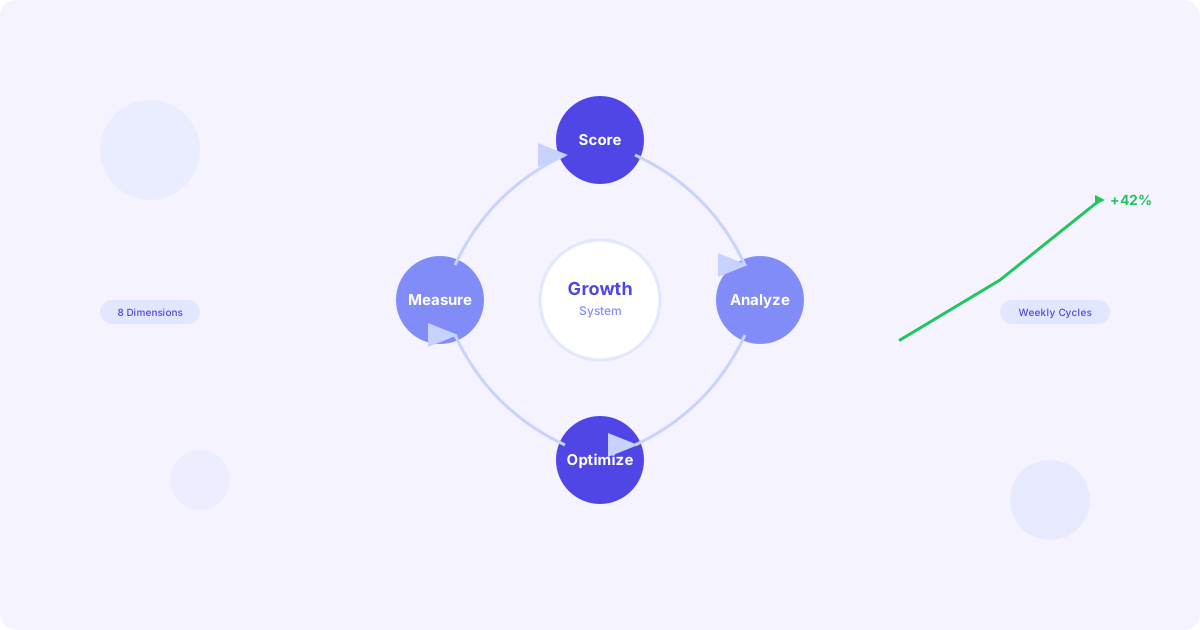
The Growth System is a fundamentally different approach. It is a continuous optimization methodology that treats your Amazon listings as living assets — scored, analyzed, improved, and measured in repeating cycles. Instead of guessing what works, you use data to identify exactly what is holding each listing back, fix it, and track the results.
In this guide, we explain what the Growth System is, why it works, and how you can apply it to your own Amazon business.
Why One-Time Optimization Fails
The traditional approach to listing optimization has a critical flaw: the Amazon marketplace is not static. Several factors change constantly:
- Competitor behavior — New sellers enter your category, existing competitors update their listings, and pricing shifts daily
- Search algorithm updates — Amazon’s A10 algorithm evolves, changing how it weighs ranking factors
- Consumer language — The search terms shoppers use shift with trends, seasons, and cultural moments
- Amazon features — New listing capabilities (A+ Premium, Rufus AI shopping, Brand Story) create fresh optimization opportunities
- Your own product evolution — New product versions, packaging updates, and customer feedback reveal new angles
A listing optimized six months ago may have been excellent then. Today, it could be underperforming on multiple dimensions without you realizing it. The gap between your current listing quality and the optimal state widens over time unless you actively maintain it.
The Core Concept: Score, Analyze, Optimize, Measure
The Growth System operates as a four-phase cycle that repeats on a weekly or biweekly cadence:
Phase 1: Score
Every listing receives a composite Quality Score from 0 to 100. This score is not a single number pulled from thin air. It is built from eight measurable dimensions that together determine how well your listing performs:
- Keyword Coverage — Are you indexed for the search terms your customers actually use?
- Content Completeness — Are you using all available character limits and content fields?
- Readability — Can shoppers quickly scan and understand your listing?
- Persuasion — Does your copy compel visitors to add the product to their cart?
- Compliance — Does your listing follow Amazon’s style guide and avoid prohibited phrases?
- Image Quality — Do your images meet Amazon’s technical requirements and best practices?
- Backend Optimization — Are your hidden fields (search terms, subject matter) fully utilized?
- Semantic Richness — Does your content answer the questions that AI shopping assistants like Rufus evaluate?
Each dimension gets its own sub-score. The composite Quality Score is a weighted average that reflects the overall health of your listing. This gives you a single number to track over time while also revealing exactly which areas need attention.
Phase 2: Analyze
Raw scores become actionable when you understand what is dragging them down. The analysis phase identifies:
- Weakest dimensions — Which of the eight quality dimensions has the lowest score?
- Specific gaps — Within each dimension, what specific issues exist? Missing keywords, incomplete bullet points, readability problems?
- Priority ranking — Which improvements will have the largest impact on your ranking and conversion rate?
- Competitor comparison — How does your listing score compare to the top sellers in your category?
This analysis transforms a number into a plan. Instead of wondering what to improve, you know exactly where to focus your effort for maximum return.
Phase 3: Optimize
With a clear understanding of what needs improvement, you make targeted changes. The Growth System emphasizes targeted optimization over wholesale rewrites:
- Fix the weakest dimension first — A listing scoring 90 on keywords but 45 on readability should focus on readability, not more keyword research
- Make measurable changes — Each optimization should be specific enough to measure its impact
- Preserve what works — Do not rewrite high-scoring sections; focus your effort on the gaps
- Use AI as a starting point — AI-generated content optimized for both search algorithms and human readers gives you a strong baseline to customize
The key insight is that small, targeted improvements to your weakest areas produce outsized results compared to broad rewrites of already-decent content.
Phase 4: Measure
After implementing changes, you track the impact across multiple metrics:
- Quality Score change — Did the composite score improve? By how much?
- Dimension-level movement — Did the targeted dimension actually improve?
- Search rank shifts — Are you ranking higher for your target keywords?
- Session and conversion data — Are more shoppers viewing and purchasing from your listing?
- Revenue impact — Ultimately, did the changes drive more sales?
Measurement closes the loop. It validates what worked, reveals what did not, and feeds directly into the next cycle’s scoring phase. Over time, you build a data-driven understanding of what moves the needle for your specific products and category.
Why Continuous Beats One-Time
The compounding effect of continuous optimization is the Growth System’s most powerful feature. Consider the math:
A single optimization pass might improve your listing from a Quality Score of 55 to 72. That is a meaningful jump. But then your score slowly decays as competitors improve, search patterns shift, and new Amazon features emerge. Within 3-6 months, you might be back to 60.
With the Growth System running weekly cycles, the pattern looks different:
- Week 1: Score 55 to 62 (focused on keyword coverage)
- Week 2: Score 62 to 68 (improved readability)
- Week 3: Score 68 to 74 (better backend optimization)
- Week 4: Score 74 to 79 (enhanced semantic richness for Rufus)
- Week 5-8: Score 79 to 87 (refinements across all dimensions)
Each cycle builds on the previous one. The improvements compound. And because you are continuously measuring, you catch and correct any regression quickly rather than discovering it months later.
The Eight Quality Dimensions in Detail
Understanding each dimension helps you interpret your scores and prioritize your optimization efforts.
Keyword Coverage (Visibility)
This dimension measures how many relevant search terms your listing contains. It goes beyond just having keywords — it evaluates whether you cover the full semantic field that shoppers use to find products like yours.
What high scores look like: Your listing contains primary, secondary, and long-tail keywords. You cover common misspellings and synonym variations. Your backend search terms add coverage for terms not in your visible content.
What low scores indicate: You are missing important search terms. Shoppers searching for your type of product with certain common phrases will not find you.
Content Completeness (Structure)
Amazon provides significant space for listing content: 200 characters for titles, 500 characters per bullet point, 2,000 characters for descriptions, and 249 bytes for backend search terms. Most sellers use only a fraction of this space.
What high scores look like: You use 85% or more of available character limits. All five bullet points are populated with substantive content. Your description adds unique information not covered in bullets.
What low scores indicate: You have empty or minimal fields. There is unused space where you could add valuable content.
Readability (Conversion)
A listing that is technically complete but difficult to read will not convert well. This dimension evaluates sentence structure, formatting, and scannability.
What high scores look like: Short sentences mixed with medium ones. Clear benefit statements. Logical information hierarchy. Easy to scan in 10 seconds.
What low scores indicate: Run-on sentences. Dense paragraphs without structure. Technical jargon without explanation. Information buried in walls of text.
Persuasion (Conversion)
Beyond readability, this dimension measures whether your content actually motivates purchasing. It looks for benefit-driven language, social proof cues, urgency, and clear value propositions.
What high scores look like: Features are translated into benefits. The copy addresses customer pain points. There is a clear reason to buy now rather than later.
What low scores indicate: Feature lists without context. No emotional appeal. Missing use-case scenarios. No differentiation from competitors.
Compliance (Safety)
Amazon has strict listing guidelines. Violating them can get your listing suppressed or your account penalized. This dimension checks for prohibited phrases, restricted claims, and style guide violations.
What high scores look like: No prohibited claims (medical, environmental, or unsubstantiated superlatives). Proper capitalization and punctuation per Amazon’s style guide. No competitor brand name misuse.
What low scores indicate: Your listing contains phrases that could trigger suppression. You are making claims that require documentation you may not have.
Image Quality (Visual)
While the Growth System focuses primarily on content optimization, image quality is scored as a dimension because images significantly impact conversion rates.
What high scores look like: Main image meets technical requirements. You use 7 or more image slots. Infographics and lifestyle images complement text content.
What low scores indicate: Missing image slots. Low-resolution images. Main image does not meet Amazon’s guidelines.
Backend Optimization (Visibility)
Backend fields are invisible to shoppers but critical for discoverability. This dimension evaluates your search terms, subject matter, and catalog attributes.
What high scores look like: All 249 bytes of search terms used without repeating words from visible content. Subject matter and intended use fields populated. Catalog attributes complete.
What low scores indicate: Empty or partially filled backend fields. Wasted bytes on words already in your visible listing. Missing catalog attributes.
Semantic Richness (AI-Readiness)
This newest dimension reflects the rise of AI-powered shopping tools like Amazon’s Rufus. It measures whether your content provides the context and detail that AI assistants need to recommend your product.
What high scores look like: Content includes use-case scenarios, comparison context, Q&A-style information, and natural language descriptions that AI can parse and present to shoppers.
What low scores indicate: Your content is keyword-optimized but lacks the contextual depth that AI assistants need to understand and recommend your product.
Building Your First Growth Plan
Getting started with the Growth System does not require optimizing everything at once. Here is a practical approach:
Step 1: Baseline Your Portfolio
Score all your active listings to establish a baseline. This tells you where you stand overall and identifies which products need the most attention.
Step 2: Prioritize by Impact
Not all listings deserve equal optimization effort. Focus first on products that have:
- High revenue but low Quality Scores — These have proven demand; better listings will directly increase revenue
- High traffic but low conversion — Something about the listing is turning shoppers away
- Low scores on dimensions you can control — Content issues are fixable; some dimensions require broader changes
Step 3: Run Your First Cycle
Pick your top-priority listing. Identify its weakest dimension. Make a targeted improvement. Measure the result. Repeat next week with the next-weakest dimension.
Step 4: Expand and Systematize
Once you have seen the cycle work on one listing, expand to your next-priority products. Over time, you build a regular cadence that keeps your entire portfolio optimized.
How Peaklyst Implements the Growth System
Peaklyst is purpose-built around the Growth System methodology. Every feature in the platform maps to a phase of the cycle:
- Scoring: Automated Quality Score calculation across all eight dimensions for every listing in your portfolio
- Analysis: Dimension-level breakdowns showing exactly what is driving each score up or down
- Optimization: AI-generated content that is pre-optimized for both search algorithms and human readers, with one-click publishing to Amazon
- Measurement: Performance tracking tied to optimization cycles so you can see the impact of each change
The Growth System overview goes deeper into the methodology, and the free Growth Plan Wizard lets you score any ASIN instantly to see the system in action.
Getting Started
The Growth System works whether you sell one product or a thousand. The principles are the same: score objectively, analyze the gaps, optimize strategically, and measure relentlessly.
The sellers who adopt continuous optimization consistently outperform those who set and forget their listings. The question is not whether to optimize continuously — it is how quickly you can start.
Try the free Growth Plan Wizard to see your first Quality Score, or explore the full methodology to understand the system in depth.