The Optimization Cycle: How Top Sellers Use Data to Improve Listings Weekly
A step-by-step guide to running weekly listing optimization cycles. Score, analyze, optimize, and measure -- the proven process that top Amazon sellers use to grow consistently.
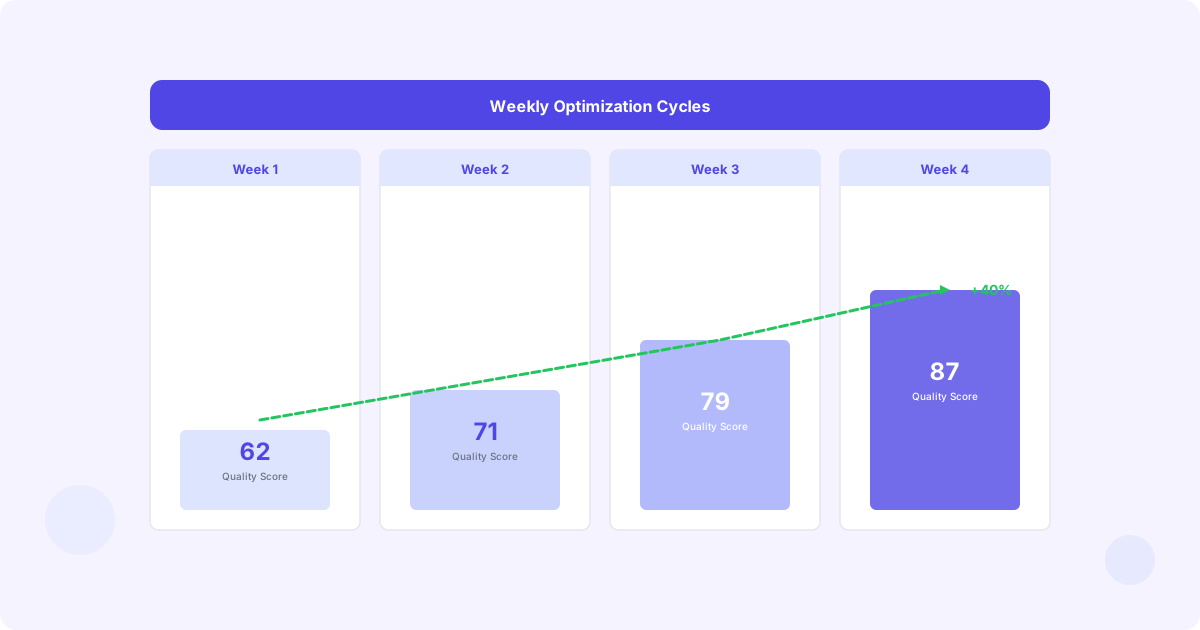
The difference between sellers who grow consistently on Amazon and those who plateau often comes down to one habit: regular, data-driven optimization cycles. Top sellers do not optimize once and hope for the best. They run structured weekly cycles that incrementally improve their listings, track what works, and compound small gains into significant revenue growth.
This guide walks you through the exact process of running a weekly optimization cycle using the Growth System methodology. Whether you manage five listings or five hundred, the framework scales.
What Is an Optimization Cycle?
An optimization cycle is a structured four-step process that you repeat regularly — ideally weekly, at minimum biweekly. Each cycle follows the same pattern:
- Score your listings to establish current quality baselines
- Analyze the scores to identify the highest-impact improvement opportunity
- Optimize the weakest area with targeted changes
- Measure the impact of your changes on scores and business metrics
The power of this approach is in its regularity and focus. Instead of making sweeping changes and hoping something sticks, you make one targeted improvement, measure its impact, and build on what works. Over time, these incremental improvements compound.
Before Your First Cycle: Setting Up Your Baseline
Before you start cycling, you need a baseline measurement for every listing you plan to optimize. This baseline serves as your reference point for measuring progress.
Step 1: Score Every Active Listing
Run a Quality Score assessment across your portfolio. For each listing, you should know:
- Composite Quality Score (0-100)
- Sub-scores for each dimension (Keyword Coverage, Content Completeness, Readability, Persuasion, Compliance, Image Quality, Backend Optimization, Semantic Richness)
- Current business metrics (sessions, conversion rate, revenue, BSR)
Record these numbers. They are your starting point.
Step 2: Prioritize Your Portfolio
Not every listing should be optimized in the same order. Prioritize based on impact potential:
Tier 1 — High Revenue, Low Score: These listings already sell well despite suboptimal content. Improving them has the highest immediate revenue impact. A listing generating $5,000/month with a Quality Score of 55 has far more upside than a $500/month listing with the same score.
Tier 2 — High Traffic, Low Conversion: These listings get discovered but do not convert. They have a visibility problem solved but a conversion problem to fix. Improving readability and persuasion scores can unlock significant revenue from existing traffic.
Tier 3 — Low Score Across the Board: These listings need fundamental work. They may be new products that were launched with minimal content or older listings that were never properly optimized.
Tier 4 — High Score, Maintenance Mode: Listings scoring 80+ across all dimensions need less frequent attention. Check them monthly rather than weekly to catch any regression.
Step 3: Create Your Cycle Calendar
Block time each week for optimization work. A typical schedule might look like:
- Monday: Score review and analysis (30 minutes)
- Tuesday-Wednesday: Content optimization (1-2 hours depending on scope)
- Thursday: Publish changes to Amazon
- Friday: No listing changes (let Amazon index your updates)
- Following Monday: Measure the impact of last week’s changes
This cadence ensures changes have at least four days to affect metrics before you evaluate them. Making changes daily and measuring daily leads to noise — you will chase randomness rather than signal.
Week-by-Week: Your First Four Cycles
Here is a detailed walkthrough of what your first four weekly optimization cycles should look like.
Week 1: Fix Your Weakest Dimension
Score: Run Quality Scores on your Tier 1 listings. Identify the listing with the largest gap between its potential and current performance.
Analyze: Look at the dimension-level breakdown. Find the single weakest dimension. For this example, let us say your top-priority listing has these scores:
| Dimension | Score |
|---|---|
| Keyword Coverage | 72 |
| Content Completeness | 68 |
| Readability | 44 |
| Persuasion | 56 |
| Compliance | 85 |
| Image Quality | 70 |
| Backend Optimization | 61 |
| Semantic Richness | 48 |
| Composite | 63 |
The weakest dimensions are Readability (44) and Semantic Richness (48). Start with Readability because it has the most direct impact on conversion rate.
Optimize: Review the readability analysis to understand why it scored low. Common issues include:
- Run-on sentences (over 25 words)
- Dense paragraphs without line breaks
- Technical jargon without explanation
- No clear information hierarchy
- Wall-of-text bullet points
Make targeted changes:
- Break long sentences into shorter ones (aim for 12-18 words average)
- Start each bullet point with a bolded benefit statement
- Use parallel sentence structure across bullet points
- Replace jargon with everyday language
- Ensure the first 150 characters of the description are the most compelling
Measure (next Monday): Check the new Readability score. It should improve significantly — a jump from 44 to 65+ is typical with focused attention. Also note any changes in conversion rate, though one week may not show a statistically significant shift.
Week 2: Address the Second-Weakest Dimension
Your listing’s readability improved from 44 to 67. The new weakest dimension is Semantic Richness at 48.
Analyze: Semantic Richness measures how well your content serves AI shopping assistants and comparison shoppers. Low scores typically mean:
- No use-case scenarios described
- Missing comparison context (how your product differs from alternatives)
- No Q&A-style content (anticipating common shopper questions)
- Thin descriptions that lack the contextual depth AI assistants need
Optimize: Add contextual depth to your listing:
- Include 2-3 specific use-case scenarios in bullet points (“Perfect for kitchen countertops with limited space” rather than “Compact design”)
- Add comparison context (“Unlike traditional models that require batteries, this unit runs on USB-C power”)
- Anticipate common questions in your description (“Wondering if this fits standard US outlets? Yes — it includes a 6-foot UL-certified power cord”)
- Use natural language patterns that AI assistants can parse and present to shoppers
Measure: Check the Semantic Richness score improvement. Also check whether your listing starts appearing in Rufus-generated answers for relevant queries. This dimension has a longer feedback loop — AI-related improvements may take 2-3 weeks to show in traffic data.
Week 3: Expand Keyword Coverage
With readability and semantic richness improved, the scores might now look like:
| Dimension | Score | Change |
|---|---|---|
| Keyword Coverage | 72 | — |
| Content Completeness | 70 | +2 (side effect of added content) |
| Readability | 67 | +23 |
| Persuasion | 58 | +2 (side effect of better writing) |
| Compliance | 85 | — |
| Image Quality | 70 | — |
| Backend Optimization | 61 | — |
| Semantic Richness | 63 | +15 |
| Composite | 71 | +8 |
The composite jumped from 63 to 71 in two weeks. Notice that even dimensions you did not directly target improved slightly — this is common because better writing naturally incorporates more keywords and persuasive elements.
Now Keyword Coverage (72) and Backend Optimization (61) are the weakest areas. Attack Backend Optimization because it is lower.
Analyze: Review your backend search terms. Common issues:
- Wasted bytes repeating words from your visible listing
- Missing misspellings and alternate spellings
- No Spanish or alternate language terms
- Subject matter and intended use fields empty
- Missing catalog attributes
Optimize:
- Audit your backend search terms against your visible content. Remove any duplicated words.
- Add common misspellings (e.g., “stainles steal” if you sell stainless steel products)
- Add Spanish terms for your product type if selling on the US marketplace
- Fill in Subject Matter, Target Audience, and Intended Use fields
- Complete all applicable catalog attributes (material, color, size, pattern)
Measure: Backend optimization changes typically take 48-72 hours to fully index. Check your indexed keyword count and any new ranking positions the following week.
Week 4: Strengthen Persuasion
After three weeks, your composite score has risen from 63 to approximately 75. Persuasion at 58 is now the weakest conversion-side dimension.
Analyze: Persuasion scoring evaluates:
- Feature-to-benefit translation (not just what the product has, but why it matters)
- Pain point addressing (connecting to the problem the shopper is trying to solve)
- Social proof language (credibility signals)
- Clear differentiation from competitors
- Call-to-action language
Optimize:
- Rewrite bullet points to lead with the benefit, then support with the feature: “Cook meals 3x faster — 1800W induction heating delivers restaurant-grade power” instead of “1800W induction heating element”
- Address specific pain points: “No more scrubbing burnt food — our ceramic coating releases stuck-on food with a simple wipe”
- Add credibility details: exact numbers, test results, certifications
- Include at least one bullet point that directly differentiates from competing products
Measure: Persuasion improvements directly affect conversion rate. Track unit session percentage closely for the next 2-3 weeks. A 2-4 percentage point improvement in conversion rate is a meaningful result.
Reading Quality Score Breakdowns
Understanding how to interpret your Quality Score breakdown is essential for efficient optimization. Here are the key principles:
The 70-Point Rule
Dimensions scoring below 70 are the highest priority. They represent clear deficiencies that are holding your listing back. Above 70, improvements produce diminishing returns. Above 85, you are in the top tier and should focus elsewhere.
Dimension Interactions
Dimensions are not independent. Improving one often affects others:
- Readability improvements lift Persuasion — Clearer writing is inherently more persuasive
- Keyword Coverage improvements can hurt Readability — If you add keywords carelessly, sentences get clunky
- Semantic Richness improvements boost Keyword Coverage — Adding contextual content naturally introduces relevant search terms
- Content Completeness improvements boost everything — Using more available space gives you room to address all dimensions
Being aware of these interactions helps you choose which dimension to target. If readability is low and you improve semantic richness, you will likely see a readability bump too — making that a high-leverage choice.
Velocity vs. Magnitude
Pay attention to both how fast scores improve and how much they improve:
- High velocity, low magnitude — Small improvements each week. Steady progress. Typical for listings that are already decent.
- Low velocity, high magnitude — Big improvements that take multiple weeks. Common when tackling fundamental issues like rewriting a keyword-stuffed title.
- Declining scores — Something changed. Check for competitor actions, algorithm updates, or unintended regressions from your own changes.
Which Dimensions to Prioritize
When multiple dimensions score below 70, use this priority framework:
Priority 1: Compliance
Always fix compliance issues first. Prohibited phrases can get your listing suppressed, costing you 100% of revenue from that product. This is a safety issue, not an optimization issue.
Priority 2: Readability
Readability affects every other conversion dimension. If shoppers cannot parse your content, nothing else matters — not your keywords, not your persuasion, not your semantic richness. Fix readability before investing in other conversion dimensions.
Priority 3: Keyword Coverage
If your listing is readable but invisible, focus on keyword coverage next. You need shoppers to find you before your persuasive copy can work.
Priority 4: Backend Optimization
This is a high-leverage, low-effort dimension. Fixing backend search terms takes 15 minutes and can meaningfully increase your indexed keyword count without changing any visible content.
Priority 5: Content Completeness
Using all available space gives you room to serve both visibility and conversion goals. It is hard to balance keywords and persuasion in a half-empty listing.
Priority 6: Persuasion and Semantic Richness
Once your listing is compliant, readable, discoverable, and complete, refine the persuasive quality and contextual depth. These are the dimensions that separate good listings from great ones.
The Compounding Effect
The most important concept in weekly optimization is compounding. Each cycle’s improvement builds on the previous one. Here is why this matters mathematically:
Consider a listing that starts at Quality Score 55 and improves by an average of 4 points per cycle:
- Week 1: 55 to 59
- Week 4: 59 to 71
- Week 8: 71 to 79
- Week 12: 79 to 83 (improvements slow as you approach the ceiling)
That is a 28-point improvement over 12 weeks. The corresponding revenue impact is typically non-linear — a listing at 83 does not just perform 50% better than one at 55. It often performs 2-3x better because high-quality listings win on both ranking (more traffic) and conversion (more sales per visitor) simultaneously.
Contrast this with the one-time optimization approach: jump from 55 to 72 in a single rewrite, then slowly decay back toward 60 over the next six months as the marketplace evolves around you.
Scaling Across Your Portfolio
Once you have the cycle working for one listing, expand systematically:
Small Portfolio (5-15 listings)
Optimize one listing per week. Cycle through your entire portfolio every 2-3 months. Each listing gets direct attention regularly.
Medium Portfolio (15-50 listings)
Group listings into tiers. Optimize 2-3 Tier 1 listings per week. Give Tier 2 listings attention biweekly. Review Tier 3 monthly.
Large Portfolio (50+ listings)
Use portfolio-level scoring to identify outliers. Focus weekly cycles on the highest-impact opportunities across the portfolio. Use automated monitoring to flag any listing that drops below a threshold score.
At every scale, the principle is the same: make targeted, measurable improvements on a regular cadence. The cadence matters more than the size of each improvement.
Common Cycle Mistakes
Mistake 1: Changing Too Many Things at Once
If you rewrite the title, bullet points, description, and backend keywords in a single cycle, you cannot isolate what worked. When metrics improve (or decline), you do not know which change caused it. Make one to two targeted changes per cycle.
Mistake 2: Measuring Too Quickly
Amazon’s search index does not update instantly. Give your changes at least 4-5 days before evaluating their impact on ranking and traffic. Conversion rate changes can be measured sooner, but still need enough sessions for statistical significance.
Mistake 3: Ignoring Regression
Sometimes a listing’s score drops even though you did not change anything. This usually means competitors improved, search patterns shifted, or Amazon updated its algorithm. Do not ignore regression. It is a signal that this listing needs attention in the next cycle.
Mistake 4: Optimizing High-Score Dimensions
A listing that scores 88 on keyword coverage and 52 on persuasion should not receive keyword work. Pushing keyword coverage from 88 to 92 might take hours and produce minimal business impact. Pushing persuasion from 52 to 70 could dramatically increase conversion rate.
Mistake 5: Skipping the Measurement Phase
Optimization without measurement is guessing with extra steps. If you do not track the impact of your changes, you cannot learn what works for your specific products and category. Every cycle must include a measurement step.
Tools and Automation
Running weekly cycles manually is possible for a small portfolio but becomes impractical as you scale. Here is where automation helps:
- Automated scoring removes the manual work of evaluating each listing dimension by dimension
- Priority recommendations surface the highest-impact opportunities without requiring you to compare scores across dozens of listings
- AI-generated content provides optimized copy as a starting point, reducing the time from analysis to implementation
- Performance tracking ties business metrics to optimization cycles automatically
Peaklyst is built around this exact workflow. The platform automates scoring, highlights priority dimensions, generates AI-optimized content, and tracks performance — reducing a full optimization cycle from hours to minutes. Learn more about the full optimization cycle methodology or score your first listing for free.