Amazon Listing Tools Compared: AI-Powered vs Manual Optimization
A detailed comparison of Amazon listing optimization approaches -- from manual tools like Helium 10 and Jungle Scout to AI-powered platforms like Peaklyst. Learn which approach fits your business.
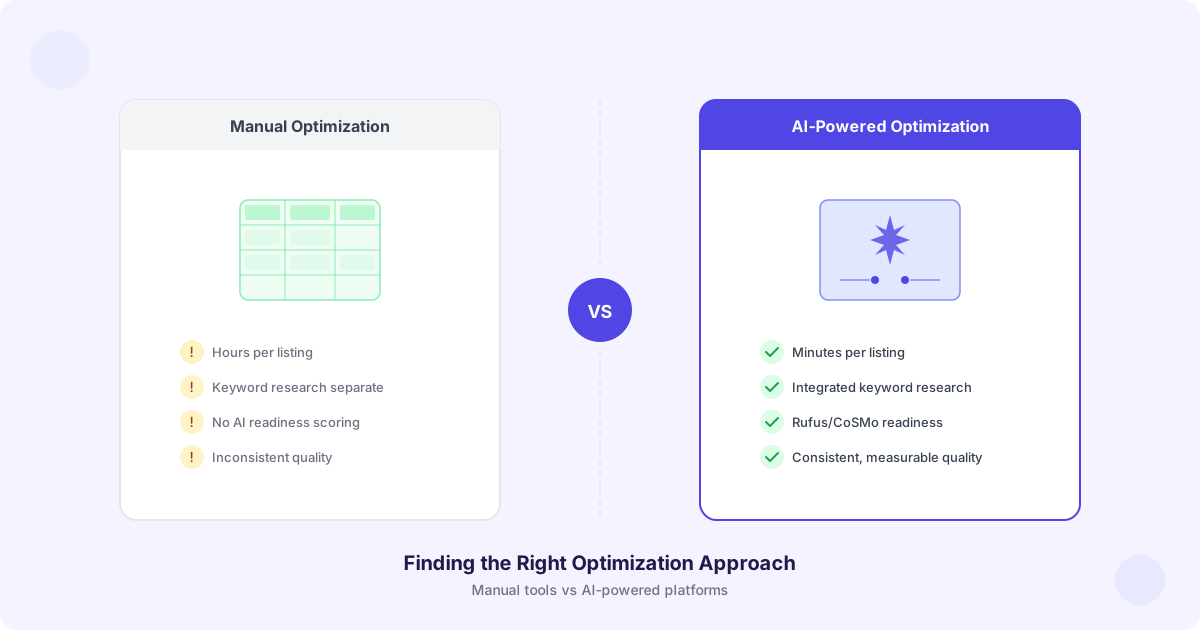
Optimizing your Amazon listings is no longer optional. In a marketplace with millions of competing products, the quality of your listing content directly determines whether shoppers find and buy your product. But the tools and approaches available for optimization vary wildly in cost, time investment, and results.
In this guide, we compare the three main approaches to Amazon listing optimization: fully manual workflows, assisted tools like Helium 10 and Jungle Scout, and fully AI-powered platforms like Peaklyst. We will be honest about the strengths and weaknesses of each so you can choose the right approach for your business.
The Three Approaches to Listing Optimization
1. Manual Optimization
Manual optimization means doing everything yourself: keyword research with free tools, writing your own copy, testing different variations, and tracking results in spreadsheets.
Who uses this approach: New sellers with limited budgets, sellers with strong copywriting skills, and brands that want direct control over every word.
How it works:
- Research keywords using Amazon autocomplete, free keyword tools, or competitor ASIN lookups
- Write listing content (title, bullet points, description, backend keywords) by hand
- Publish and monitor performance through Seller Central reports
- Iterate based on results, usually on an ad-hoc basis
Strengths:
- Zero software cost beyond Amazon Seller Central
- Complete control over voice, tone, and messaging
- Deep understanding of your product translates directly to content
- No learning curve for external tools
Weaknesses:
- Extremely time-intensive (2-4 hours per listing for thorough optimization)
- Keyword research is limited without access to comprehensive databases
- No way to score or benchmark listing quality objectively
- Inconsistent results across listings, especially for larger catalogs
- Does not account for emerging factors like Rufus/CoSMo readiness
- No systematic framework for ongoing optimization
Cost: Free (your time excluded). If you value your time at $50/hour, a single listing optimization costs $100-200.
2. Assisted Tools (Helium 10, Jungle Scout, and Similar)
Assisted tools provide keyword research data, listing scoring, and sometimes AI-assisted content suggestions. The seller still makes all decisions and does most of the writing, but with better data to inform those decisions.
Who uses this approach: Established sellers, agencies, and sellers with 10-100+ ASINs who need research data at scale.
Helium 10
Helium 10 is one of the most comprehensive Amazon seller tool suites. For listing optimization specifically, it offers:
- Cerebro: Reverse ASIN keyword lookup — see exactly which keywords your competitors rank for
- Magnet: Forward keyword research with search volume estimates
- Frankenstein: Keyword processor for deduplication and cleanup
- Scribbles: Listing editor that tracks keyword usage as you write
- Listing Builder: AI-assisted listing creation with keyword integration
Strengths of Helium 10:
- Industry-leading keyword database with accurate search volume data
- The Scribbles tool provides real-time keyword tracking as you write
- Comprehensive suite covers many aspects of Amazon selling beyond listing optimization
- AI Listing Builder generates content that can serve as a starting point
- Large community and extensive educational resources
Weaknesses of Helium 10:
- Listing Builder AI output often needs significant manual editing
- Optimization is still largely manual — the tools provide data, not a methodology
- No Rufus/CoSMo readiness scoring or conversational AI optimization
- Pricing starts at $29/month (Starter) but the features most useful for listing optimization require the Platinum plan at $79/month
- Learning curve for the full suite is significant
Jungle Scout
Jungle Scout is known primarily for product research but has expanded into listing optimization:
- Keyword Scout: Keyword research with search volume and PPC data
- Listing Builder: AI-powered listing creation from keywords
- AI Assist: Generates listing content from product details and keywords
- Review Analysis: Identifies themes from customer reviews
Strengths of Jungle Scout:
- Clean, intuitive interface with a shorter learning curve than Helium 10
- AI Assist generates surprisingly coherent first drafts
- Review Analysis provides genuine insight into what customers value
- Strong product research tools complement optimization workflow
- Pricing starts at $49/month for the Starter plan
Weaknesses of Jungle Scout:
- Keyword database is smaller than Helium 10 for some categories
- AI-generated content is generic and rarely reflects brand voice
- No ongoing optimization framework — treats listing creation as a one-time event
- No CoSMo or conversational AI readiness evaluation
- Limited catalog management for sellers with many ASINs
Other Assisted Tools
Other tools in this category include:
- DataDive / SmartScout: Strong keyword and market research, limited listing optimization features
- SellerApp: Listing quality scoring with keyword tracking
- Viral Launch: Keyword research and listing builder with market intelligence
General strengths of assisted tools:
- Provide data you cannot get from Amazon Seller Central alone
- Keyword tracking helps ensure search term coverage
- AI features can generate reasonable first drafts
- Most offer free trials or limited free plans
General weaknesses of assisted tools:
- The seller is still responsible for the final content quality
- No methodology for continuous optimization (optimize once, hope for the best)
- AI-generated content rarely accounts for conversion optimization or AI readiness
- Tool subscriptions add up ($50-200/month across tools)
- Integration between research and execution is often clunky
3. AI-Powered Optimization (Peaklyst)
AI-powered optimization takes a fundamentally different approach. Instead of providing data for the seller to act on, it generates production-ready content, scores it across multiple quality dimensions, and provides a methodology for continuous improvement.
Who uses this approach: Sellers who want measurable quality improvements without investing hours per listing, brands scaling optimization across large catalogs, and sellers who want to optimize for emerging factors like Rufus/CoSMo.
How Peaklyst works:
- Connect your Amazon account via secure OAuth — your listings are imported automatically
- AI analyzes each listing and scores it across keyword coverage, content completeness, conversion readiness, and CoSMo/Rufus readiness
- AI generates optimized content — titles, bullet points, descriptions, and backend keywords — informed by keyword data, category benchmarks, and your brand voice
- Review and publish with a single click, with compliance checking and word-level diff preview
- Growth System methodology identifies whether each listing’s bottleneck is visibility or conversion, then runs 4-8 week optimization cycles with measurable targets
Strengths:
- Minutes per listing instead of hours
- Consistent quality across entire catalog
- Rufus/CoSMo readiness scoring and optimization (unique in the market)
- Built-in methodology for continuous improvement, not just one-time optimization
- Compliance checking catches policy violations before publishing
- One-click Amazon publishing with diff preview
- 30% lower pricing than comparable platforms
Weaknesses:
- Less granular control over individual word choices (though full editing is available)
- Newer platform with a smaller user community compared to established tools
- AI-generated content benefits from human review for brand-specific nuances
- Requires trust in AI-generated content (mitigated by review workflow)
Side-by-Side Comparison
| Factor | Manual | Helium 10 / Jungle Scout | Peaklyst |
|---|---|---|---|
| Time per listing | 2-4 hours | 30-60 minutes | 5-10 minutes |
| Keyword research | Limited (free tools) | Comprehensive databases | Integrated with content |
| Content generation | Write from scratch | AI-assisted first draft | Production-ready AI content |
| Quality scoring | None (subjective) | Basic listing score | Multi-dimensional (4+ scores) |
| CoSMo/Rufus readiness | Not available | Not available | Built-in scoring and optimization |
| Optimization methodology | Ad hoc | Data-informed but manual | Growth System (structured cycles) |
| Compliance checking | Manual review | Limited | Automated (300+ rules) |
| Publishing workflow | Copy-paste to Seller Central | Copy-paste or limited API | One-click with diff preview |
| Monthly cost | $0 (time cost only) | $29-249/month | Starting lower than competitors |
| Best for | 1-5 listings, tight budget | Research-heavy sellers, agencies | Scale-focused, quality-driven sellers |
When Each Approach Makes Sense
Choose Manual Optimization When:
- You have fewer than 5 ASINs and strong copywriting skills
- Your budget is extremely limited and your time is not
- You sell in a niche category where you have deep domain expertise
- You want to learn the fundamentals before investing in tools
Choose Helium 10 When:
- Keyword research data is your primary need
- You sell in competitive categories where knowing competitor keywords is critical
- You have a team or VA who can execute on the research data
- You need a comprehensive suite that covers research, optimization, and PPC together
Choose Jungle Scout When:
- You are combining product research with listing optimization
- You prefer a cleaner, less overwhelming interface
- AI-assisted content is a starting point you are comfortable editing significantly
- You are earlier in your Amazon selling journey and want an all-in-one tool
Choose Peaklyst When:
- You have 10+ ASINs and need consistent optimization at scale
- You want to optimize for Rufus/CoSMo readiness (no other tool offers this)
- You value a structured methodology over ad-hoc optimization
- Time efficiency matters — you want minutes per listing, not hours
- You want compliance checking and one-click publishing in the same workflow
- Continuous improvement through measurable optimization cycles appeals to you
The Hidden Cost of the Wrong Approach
Choosing the wrong optimization approach is not just about the subscription fee. The real costs are:
Opportunity cost of poor optimization: A listing that converts at 8% instead of 12% leaves significant revenue on the table, especially at scale across dozens or hundreds of ASINs.
Time cost of manual processes: A seller with 50 ASINs spending 2 hours per listing on manual optimization invests 100 hours just for the initial pass. Quarterly refreshes add another 200 hours per year.
Compounding quality gap: Sellers using methodology-driven optimization improve their listings systematically over time. Each 4-8 week cycle compounds. Sellers optimizing ad hoc fall further behind with each cycle.
AI readiness gap: As Amazon’s Rufus continues to expand, listings not optimized for conversational AI will receive fewer impressions in AI-mediated shopping experiences. This gap will widen over time.
Combining Approaches
It is worth noting that these approaches are not mutually exclusive. Many successful sellers use a combination:
-
Helium 10 for keyword research + Peaklyst for content optimization: Use Helium 10’s Cerebro for competitive keyword intelligence, then feed those insights into Peaklyst’s AI content generation for production-ready listings.
-
Manual optimization for hero ASINs + AI for long-tail: Spend manual effort on your top 5 products where every word matters, then use AI-powered optimization for the rest of your catalog.
-
Jungle Scout for product research + Peaklyst for listing execution: Use Jungle Scout to validate product opportunities and understand market dynamics, then use Peaklyst to create and maintain optimized listings.
The key is matching your tools to your actual workflow rather than paying for capabilities you do not use.
Making Your Decision
The listing optimization landscape is evolving rapidly. Two years ago, the only options were manual work or keyword research tools. Today, AI-powered platforms offer a fundamentally different approach that saves time and delivers measurable quality.
Here is our honest recommendation:
-
If you are just starting on Amazon, learn the fundamentals with manual optimization first. Understanding what makes a good listing will make you a better evaluator of any tool’s output.
-
If you are established and data-hungry, tools like Helium 10 and Jungle Scout provide excellent keyword research. They are proven, well-supported, and the industry standard for good reason.
-
If you want to optimize at scale with consistent quality, consider an AI-powered approach. The time savings alone justify the investment for sellers with more than 10 ASINs.
-
If Rufus/CoSMo readiness matters to you (and it should — conversational commerce is growing rapidly), Peaklyst is currently the only platform that scores and optimizes for it.
The best tool is the one you actually use consistently. Pick the approach that fits your workflow, budget, and growth stage, and commit to regular optimization cycles rather than one-time fixes.
Ready to see how your listings score? Try the free Growth Plan Wizard for an instant quality assessment, or visit our detailed comparison page for a feature-by-feature breakdown.