A10 Algorithm Ranking Factors: The Complete 2026 Guide
Everything you need to know about Amazon's A10 search algorithm in 2026. From keyword relevance and sales velocity to click-through rates and external traffic signals.
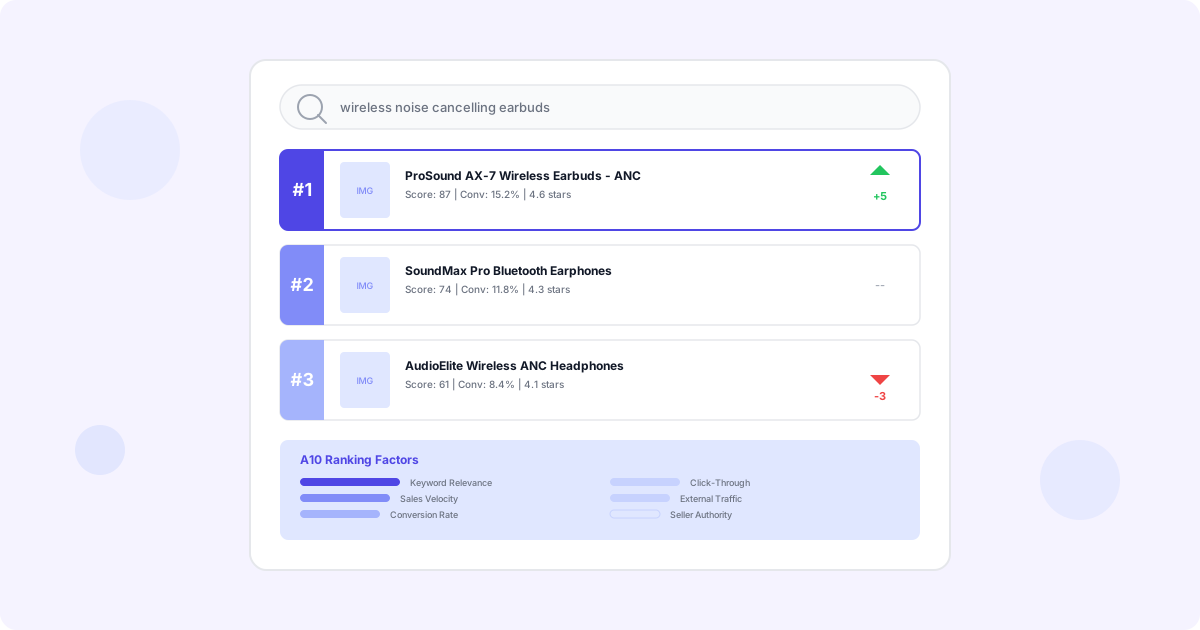
Amazon’s A10 algorithm determines which products appear when shoppers search for a keyword — and in what order. Understanding how A10 works is essential for any seller who wants to grow organic traffic and reduce dependence on paid advertising.
This guide covers every known ranking factor in the A10 algorithm as of 2026, how each factor works, and what you can do to improve your standing on each one. We also explain how A10 differs from its predecessor (A9) and what the rise of AI-driven shopping means for search ranking.
A10 vs. A9: What Changed
Amazon’s search algorithm has evolved significantly. The transition from A9 to A10 shifted the weight of several ranking factors:
| Factor | A9 Weight | A10 Weight | Direction |
|---|---|---|---|
| Keyword relevance | High | High | Stable |
| Sales velocity | Very high | High | Decreased |
| PPC influence on organic rank | High | Medium | Decreased |
| External traffic | Low | Medium-High | Increased |
| Click-through rate | Medium | High | Increased |
| Seller authority | Low | Medium | Increased |
| Conversion rate | High | High | Stable |
| Organic sales vs. PPC sales | Not weighted | Weighted | New |
The most significant shifts are:
- External traffic matters more. A10 rewards products that drive traffic from outside Amazon (social media, Google, blogs, email). This was negligible under A9.
- Organic sales are weighted higher than PPC sales. Under A9, a sale was a sale regardless of source. A10 gives more ranking credit to organic purchases.
- PPC has less direct ranking influence. You can no longer PPC your way to the top of organic results as easily as before. PPC still helps (by generating sales velocity), but the direct ranking boost is reduced.
- Click-through rate matters more. A10 pays more attention to how often shoppers click on your listing from search results, making your title and main image more important than ever.
The Six Core Ranking Factors
1. Keyword Relevance
Weight: Very High
Keyword relevance remains the foundation of Amazon search ranking. If your listing does not contain the keywords a shopper searches for, your product will not appear in results — regardless of how well it performs on every other factor.
How Amazon evaluates keyword relevance:
- Exact match — Your listing contains the exact search phrase (e.g., “wireless noise cancelling earbuds”)
- Phrase match — Your listing contains the words in the same general order (e.g., “wireless earbuds with noise cancelling technology”)
- Broad match — Your listing contains all the individual words but in different locations (e.g., “wireless” in title, “noise cancelling” in bullet 3, “earbuds” in description)
Exact and phrase matches carry more weight than broad matches. Title keywords carry more weight than bullet point keywords, which carry more than description keywords. Backend search terms carry weight for indexing but less for ranking.
How to optimize:
- Place your 2-3 most important keywords in your title as exact or phrase matches
- Distribute secondary keywords across bullet points, aiming for phrase matches where natural
- Use the description for long-tail keyword variations and contextual coverage
- Fill backend search terms with keywords that did not fit naturally into visible content
- Do not repeat words between visible content and backend terms — Amazon indexes each word once
For a comprehensive keyword research strategy, see our Amazon Keyword Research Guide.
2. Sales Velocity
Weight: High
Sales velocity measures how many units you sell per time period, with recent sales weighted more heavily than older ones. Products that sell consistently and at increasing rates rank higher than products with flat or declining sales.
How Amazon evaluates sales velocity:
- Daily sales rate — Average units sold per day over rolling 7-day and 30-day windows
- Sales trend — Is velocity increasing, stable, or declining? Increasing velocity receives a ranking boost.
- Category-relative performance — Your velocity is compared to other products in your subcategory. Selling 10 units/day in a niche category is more impressive than 10 units/day in a high-volume category.
How to optimize:
- Launch with momentum — Use promotions, deals, and PPC to establish initial sales velocity for new products
- Avoid stockouts — Going out of stock kills your velocity metrics and takes weeks to recover
- Use time-limited deals — Lightning Deals and 7-Day Deals create velocity spikes that boost ranking
- Maintain promotional cadence — Regular coupons and Subscribe & Save keep velocity consistent
- Improve conversion rate — More traffic turning into sales increases velocity without increasing ad spend
3. Conversion Rate
Weight: High
Conversion rate (Unit Session Percentage on Amazon) measures what percentage of listing visitors make a purchase. A high conversion rate signals to Amazon that your listing effectively matches shopper intent — exactly what Amazon wants in its search results.
Typical conversion rates by context:
- Overall Amazon average: 12-15%
- Well-optimized listings: 15-25%
- Niche/specialty products: 20-35%
- Highly competitive categories: 8-12%
How to optimize:
- Listing quality — This is where the Growth System’s eight quality dimensions directly impact ranking. Better readability, persuasion, images, and content completeness all improve conversion rate.
- Pricing — Competitive pricing relative to similar products. Not necessarily the cheapest, but aligned with perceived value.
- Reviews — Higher ratings and more reviews increase buyer confidence. Focus on product quality and customer experience to earn organic reviews.
- A+ Content — Enhanced brand content (for Brand Registered sellers) can increase conversion rate by 3-10% according to Amazon’s own data.
- Answer common objections — If shoppers frequently have the same concern, address it directly in your listing content.
4. Click-Through Rate (CTR)
Weight: High (increased in A10)
Click-through rate measures how often shoppers click on your listing when it appears in search results. A high CTR tells Amazon that your product is relevant and appealing for a given search term.
What influences CTR from search results:
- Title — The first 80-100 characters are visible in search results. This is your most important CTR lever.
- Main image — The primary photo is the largest visual element in search results. Professional, clear, high-contrast images get more clicks.
- Price — Price is displayed prominently. Competitive pricing (including crossed-out “was” pricing from coupons) improves CTR.
- Rating and review count — Star rating and review count are visible in search results. Higher ratings with more reviews drive more clicks.
- Badge indicators — “Amazon’s Choice,” “Best Seller,” Prime badge, and deal badges all improve CTR.
- Coupon badge — The green coupon badge in search results significantly increases CTR.
How to optimize:
- Front-load your title — Put the most compelling, differentiating information in the first 80 characters. Brand name, key feature, and primary benefit should all be visible without clicking.
- Invest in your main image — Use professional photography with high contrast against the white background. The product should fill at least 85% of the frame.
- Use coupons strategically — Even a 5% coupon triggers the green badge, which increases CTR disproportionately to the discount amount.
- Monitor your title on mobile — Over 70% of Amazon traffic is mobile. Check how your title appears on phone screens and optimize the first 60 characters for mobile.
5. External Traffic
Weight: Medium-High (significant increase in A10)
A10 rewards products that bring traffic to Amazon from external sources. This makes sense from Amazon’s perspective: sellers who drive their own traffic are bringing new customers to the platform.
External traffic sources that influence ranking:
- Social media — Links from Instagram, TikTok, Facebook, Pinterest
- Google search — Organic or paid Google traffic that lands on your Amazon listing
- Blogs and content marketing — Articles that link to your Amazon product page
- Email marketing — Newsletters and promotional emails directing subscribers to Amazon
- Influencer collaborations — Content creators linking to your product
- Brand website — Your own website linking to Amazon listings
How to optimize:
- Amazon Attribution — Use Amazon Attribution links to track external traffic and demonstrate its value to the algorithm
- Social media strategy — Post product content on social platforms with direct links to your Amazon listing
- Google SEO — Optimize your Amazon listing title and content for Google search terms (Amazon listings often rank in Google results)
- Content marketing — Create blog posts, videos, or guides that reference your products
- Influencer partnerships — Work with micro-influencers in your niche who can drive targeted traffic
Important caveat: External traffic needs to be high-quality. Sending untargeted traffic that does not convert can actually hurt your ranking by lowering your conversion rate. Focus on targeted traffic from audiences likely to purchase.
6. Seller Authority
Weight: Medium (increased in A10)
Seller authority is a composite factor that reflects your overall standing as a seller on Amazon. It is the hardest factor to influence directly because it accumulates over time.
Components of seller authority:
- Account age and history — Longer-tenured sellers with clean records score higher
- Performance metrics — Order defect rate, late shipment rate, cancellation rate
- Customer feedback score — Your aggregate seller feedback rating
- Category experience — Selling history in the specific category where you are competing
- Brand Registry status — Brand Registered sellers receive authority bonuses
- Inventory performance — FBA sellers with good IPI (Inventory Performance Index) scores get an edge
How to optimize:
- Maintain excellent performance metrics — Keep order defect rate below 1%, late shipments below 4%, cancellation rate below 2.5%
- Use FBA — Fulfillment by Amazon signals reliability to the algorithm and earns the Prime badge
- Get Brand Registered — The trademark investment pays dividends in both authority and available listing features (A+ Content, Brand Store, Sponsored Brands)
- Respond to customer inquiries quickly — Amazon tracks response times and rates
- Resolve issues proactively — Address negative feedback before it becomes an A-to-Z claim
Secondary Ranking Factors
Beyond the six core factors, several secondary signals influence ranking:
Organic Sales vs. PPC Sales
A10 distinguishes between organic and PPC-driven sales. While PPC sales still improve your ranking (they generate velocity), organic sales carry more weight per unit. This means:
- A product with 20 organic sales/day will outrank a product with 20 PPC-driven sales/day, all else being equal
- The most effective strategy is using PPC to generate initial velocity, then reducing PPC as organic ranking improves
- Do not rely on PPC alone for ranking maintenance — it is a diminishing-returns strategy under A10
Listing Completeness
Amazon gives a modest ranking boost to listings that utilize all available content fields. This includes:
- Full-length title (close to 200 characters)
- All five bullet points populated with substantive content
- A description (or A+ Content for Brand Registered sellers)
- Backend search terms filled
- All applicable product attributes completed
- Seven or more product images uploaded
Browse Node and Category Relevance
Being classified in the correct browse node (category) matters more than you might expect. If your product is miscategorized:
- You compete against irrelevant products, making your conversion rate look worse
- Shoppers filtering by category will not find you
- Amazon’s category-level ranking normalization will not apply correctly
Verify your browse node classification through Seller Central and request corrections if needed.
Shipping Speed and Prime Eligibility
Prime-eligible products receive preferential treatment in search results. This is not an A10-specific factor — it has been true since Prime launched — but it remains one of the most impactful binary ranking signals.
If you are not using FBA and cannot offer Seller Fulfilled Prime, you are competing at a significant disadvantage for Prime-filtered searches, which represent the majority of Amazon traffic.
Ranking Factor Interactions
Ranking factors do not operate independently. Understanding their interactions helps you prioritize optimization:
The Conversion-Velocity Flywheel
Higher conversion rates produce more sales per session. More sales increase velocity. Higher velocity improves ranking. Better ranking means more traffic. More traffic (with maintained conversion rate) means even more sales. This is the core growth flywheel on Amazon.
The Growth System targets this flywheel directly by optimizing listing quality (conversion rate) as the most controllable input. You cannot directly control traffic, but you can control how well your listing converts the traffic it receives.
The CTR-Relevance Signal
When shoppers click on your listing for a specific search term, Amazon records that as a relevance signal. High CTR for a keyword reinforces your ranking for that keyword. Low CTR (appearing in results but rarely being clicked) can actually decrease your ranking over time.
This is why title optimization is so critical. Your title is the primary CTR lever, and CTR feeds directly into your ranking for each keyword.
The External Traffic Multiplier
External traffic is particularly powerful because it simultaneously improves multiple ranking factors:
- The traffic itself is a positive signal (external traffic factor)
- If that traffic converts, it increases sales velocity
- Those sales are organic (not PPC), which A10 weighs more heavily
- The additional sessions provide more conversion data, stabilizing your conversion rate metric
This is why sellers who invest in off-Amazon marketing often see disproportionate ranking improvements compared to their traffic volume.
Practical A10 Optimization Strategy
Based on the ranking factors above, here is a prioritized optimization strategy:
Priority 1: Listing Quality (Controls conversion rate and CTR)
Optimize your listing content using the Growth System methodology. Focus on:
- Title optimization for both keywords and click-through
- Bullet points that balance keyword coverage with persuasive benefits
- Images that differentiate your product in search results
- Complete utilization of all content fields
This is the highest-leverage work because it influences both conversion rate and CTR simultaneously.
Priority 2: Keyword Strategy (Controls relevance and indexing)
Ensure comprehensive keyword coverage using the strategies in our Keyword Research Guide:
- Primary keywords in title
- Secondary keywords in bullet points
- Long-tail variations in description
- Gap keywords in backend search terms
- Regular keyword audits to catch new trends
Priority 3: Velocity Management (Controls sales momentum)
Maintain consistent sales velocity through:
- Strategic coupon and deal cadence
- PPC campaigns targeting your most profitable keywords
- Avoiding stockouts at all costs
- Subscribe & Save enrollment where applicable
Priority 4: External Traffic (Multiplier effect)
Build external traffic sources:
- Social media product content
- Google SEO for your brand and product terms
- Email list building and marketing
- Influencer partnerships in your niche
- Amazon Attribution tracking for all external campaigns
Priority 5: Seller Authority (Long-term foundation)
Invest in the fundamentals:
- FBA enrollment for Prime eligibility
- Brand Registry for enhanced features and authority
- Excellent customer service metrics
- Clean account history
How the Growth System Connects to A10
The Growth System’s eight quality dimensions map directly to A10 ranking factors:
| Growth System Dimension | A10 Factor Influenced |
|---|---|
| Keyword Coverage | Keyword relevance |
| Content Completeness | Listing completeness, CTR |
| Readability | Conversion rate |
| Persuasion | Conversion rate, CTR |
| Compliance | Listing eligibility (suppression risk) |
| Image Quality | CTR, conversion rate |
| Backend Optimization | Keyword relevance, indexing breadth |
| Semantic Richness | AI-driven discovery (Rufus), conversion |
By optimizing across all eight dimensions, you simultaneously address the controllable A10 ranking factors. The weekly optimization cycle ensures you stay current as the algorithm evolves and competitors adapt.
Looking Ahead: A10 and AI
The rise of AI shopping assistants like Rufus adds a new dimension to the ranking equation. While A10 still governs traditional search results, Rufus-driven discovery operates on different criteria (semantic understanding, contextual depth, answer quality).
Forward-thinking sellers are optimizing for both systems simultaneously. The Growth System’s Semantic Richness dimension specifically targets Rufus readiness while maintaining strong A10 optimization across the other seven dimensions.
For more on optimizing for AI-driven discovery, see our guide on Amazon Rufus and Your Listings.
To see how your listing scores across all dimensions that influence A10 ranking, try the free Growth Plan Wizard — no account required.