Why Most Amazon Sellers Waste Money on Listing Optimization Tools
Many sellers pay for listing tools but never see results. Learn the common mistakes that waste optimization budgets and how a methodology-first approach delivers measurable ROI.
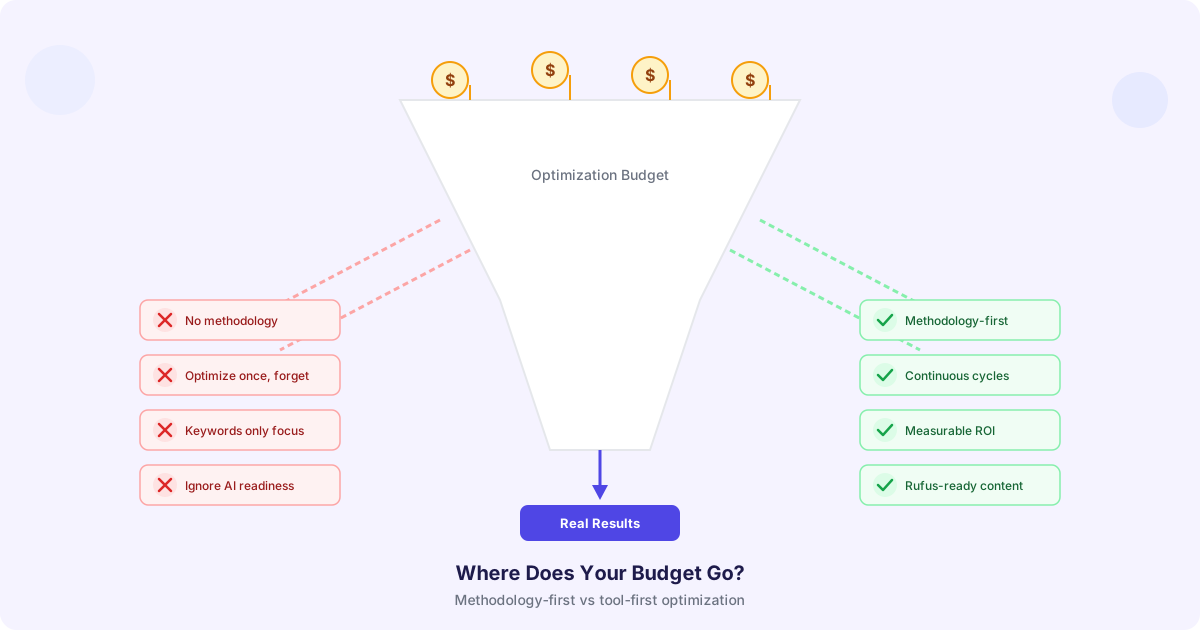
Here is a pattern we see constantly: a seller signs up for a $79/month optimization tool, spends a weekend updating their listings, sees modest results for a few weeks, and then stops using the tool. Six months later, they cancel — having spent $474 for what amounted to one afternoon of optimization work.
This is not the tool’s fault. The tool probably did exactly what it promised. The problem is that most sellers approach listing optimization as a one-time project rather than an ongoing discipline. They buy tools without a methodology, and tools without a methodology are expensive paperweights.
In this guide, we identify the five most common mistakes that cause sellers to waste their optimization budgets, and explain how a methodology-first approach delivers measurable, compounding ROI.
Mistake 1: Buying Tools Without a Methodology
The most expensive mistake sellers make is subscribing to optimization tools before they have a clear methodology for using them. A keyword research tool tells you which keywords have high search volume. But it does not tell you:
- Which keywords to prioritize for your specific listing’s situation
- Whether your listing’s problem is visibility (not enough impressions) or conversion (enough impressions but low sales)
- How to structure your content for both search algorithms and human readers
- When to refresh your optimization and what to change
- How to measure whether your changes actually worked
Without answers to these questions, sellers tend to do the most obvious thing: stuff as many high-volume keywords as possible into their listing. This approach might improve search visibility temporarily, but it often damages conversion rates because keyword-stuffed content reads poorly.
The methodology-first alternative: Before choosing any tool, define your optimization framework. The Growth System methodology provides exactly this framework by first diagnosing whether each listing’s bottleneck is visibility or conversion, then prescribing specific optimization actions with measurable targets. The tool you use to execute those actions matters less than having a clear plan for what actions to take and why.
Mistake 2: Optimizing Once and Forgetting
Amazon’s marketplace is not static. Competitors enter and leave your category. Search trends shift seasonally and year-over-year. Amazon’s own algorithms evolve — the emergence of Rufus and CoSMo has fundamentally changed how listings are evaluated. A listing optimized in January may be underperforming by April.
Yet most sellers treat optimization as a one-time event. They invest heavily in the initial optimization, see improvements, and then move on to other priorities. The listing gradually loses its competitive edge:
- Competitors copy your best keywords and content strategies
- New search trends emerge that your listing does not cover
- Amazon algorithm changes alter what content performs well
- Customer language evolves (the words shoppers use to search change over time)
- Product improvements or variations are not reflected in the listing
Research across large catalogs suggests that listings lose 15-25% of their optimization effectiveness within 90 days if not refreshed. The decline is gradual enough that sellers do not notice until they check their metrics months later.
The methodology-first alternative: Build optimization into your operational rhythm. The Growth System uses 4-8 week optimization cycles. Each cycle:
- Measures current performance (scores, rankings, conversion rate)
- Diagnoses the primary bottleneck (visibility vs conversion)
- Prescribes specific changes targeting the bottleneck
- Tracks the impact over the cycle period
- Repeats with the next bottleneck
This approach compounds over time. Each cycle builds on the previous one, and the listing gets progressively stronger. The tool cost is justified because it is being used continuously, not just once.
Mistake 3: Focusing Only on Keywords
Keywords matter. They determine whether Amazon’s search engine surfaces your product for relevant queries. But many sellers treat keyword optimization as the entirety of listing optimization, ignoring equally important factors.
A listing that ranks number one for a high-volume keyword but converts at 5% generates less revenue than a listing that ranks number five but converts at 15%. The math is straightforward:
- Listing A: Position 1, 10,000 impressions, 5% conversion = 500 sales
- Listing B: Position 5, 4,000 impressions, 15% conversion = 600 sales
Listing B generates 20% more sales with less than half the impressions. This is not a hypothetical — it reflects a pattern we observe across thousands of real listings.
Keywords drive visibility. But conversion depends on:
- Content quality: How compelling, clear, and benefit-focused your copy is
- Content completeness: Whether you use all available fields to their maximum
- Image quality: Whether your images address shopper concerns and demonstrate value
- Social proof alignment: Whether your content reinforces or contradicts your reviews
- Question answerability: Whether your listing answers the questions shoppers ask before purchasing (this is where CoSMo scoring comes in)
Most keyword tools do not measure any of these factors. They track keyword presence and rank position, which covers only one dimension of listing quality. Sellers who focus exclusively on keywords leave significant conversion improvement on the table.
The methodology-first alternative: Measure your listings across multiple dimensions, not just keyword coverage. The Growth System evaluates keyword coverage, content completeness, conversion readiness, and Rufus/CoSMo readiness as independent scores. A listing might score 90% on keywords but 40% on conversion readiness, which tells you exactly where to focus your next optimization effort.
Mistake 4: Ignoring Rufus and AI Readiness
This is the newest and arguably most consequential mistake sellers make. Amazon’s Rufus AI shopping assistant is changing how shoppers discover and evaluate products. When a customer asks Rufus “What is the best yoga mat for hot yoga?”, the AI does not simply return keyword matches. It evaluates which listings can meaningfully answer that conversational query.
Most optimization tools were built in the pre-Rufus era. They focus on keyword density, search volume, and rank tracking — all important, but increasingly insufficient. They do not evaluate:
- Whether your listing can answer common shopper questions about your product
- Whether your content reads naturally when quoted by an AI assistant
- Whether your features are described with enough specificity for AI to recommend your product confidently
- Whether your listing includes use-case scenarios that match conversational queries
- Whether your content provides comparison context that helps AI position your product
Sellers who optimize exclusively for traditional keyword algorithms are building on a platform that is actively evolving beneath them. The gap between keyword-optimized and AI-ready listings will widen as Amazon continues expanding Rufus across more categories and markets.
The methodology-first alternative: Include AI readiness as a first-class optimization dimension. The Growth System methodology incorporates CoSMo scoring alongside traditional metrics, ensuring your listings are optimized for both current search algorithms and emerging conversational AI interactions. This is not about abandoning keyword optimization — it is about extending it to cover how AI evaluates and recommends your products.
Mistake 5: Not Measuring Results
The final mistake is perhaps the most surprising: many sellers invest in optimization tools but never rigorously measure whether the optimization actually worked.
They check their BSR, glance at revenue trends, and form an impression. But impressions are unreliable. Revenue fluctuations can be caused by seasonality, competitor actions, advertising changes, pricing shifts, or inventory issues. Without isolating the impact of listing optimization specifically, you cannot know if your tool subscription is delivering ROI.
Effective measurement requires:
- Baseline metrics captured before optimization (conversion rate, sessions, keyword rankings)
- Controlled changes that isolate listing optimization from other variables (do not change your PPC bids and your listing content on the same day)
- Sufficient time for changes to take effect (at minimum 2-3 weeks for Amazon to re-index and for statistical significance)
- Specific metrics tracked against specific changes (did changing bullet points improve conversion rate? did adding backend keywords improve search visibility?)
Without this discipline, tool ROI is unmeasurable, and unmeasurable ROI eventually gets cut from the budget.
The methodology-first alternative: Bake measurement into every optimization cycle. The Growth System methodology requires baseline measurement before any changes, tracks specific metrics tied to each optimization action, and evaluates results at the end of each 4-8 week cycle. If a change did not produce results, the next cycle adjusts the approach. If it did, the gain compounds into the next cycle.
The Methodology-First Approach: How It Changes Everything
The common thread across all five mistakes is the absence of a systematic methodology. Tools are valuable, but they are execution layers. A methodology is the strategy layer that tells you:
- What to measure before you start
- What to diagnose as the primary bottleneck
- What to change based on the diagnosis
- How to measure whether the change worked
- What to do next based on the results
This is what the Growth System methodology provides. It is a structured framework for continuous listing optimization that works regardless of which tools you use to execute it. The framework has three core principles:
Principle 1: Diagnose Before You Prescribe
Every listing has a primary bottleneck — either visibility (not enough shoppers see it) or conversion (enough shoppers see it but not enough buy). The correct optimization strategy depends entirely on which bottleneck you face. Improving keywords for a listing with a conversion problem wastes effort. Improving content quality for a listing that nobody can find wastes effort.
The Growth System starts with diagnosis. It uses quantitative metrics (search rank positions, session counts, conversion rates, quality scores) to identify the primary bottleneck for each listing. Only then does it prescribe specific optimization actions.
Principle 2: Optimize in Cycles, Not Events
One-time optimization decays. Market conditions change. Competitors adapt. Algorithms evolve. The Growth System uses 4-8 week optimization cycles that continuously adapt your listings to current market conditions.
Each cycle focuses on the current bottleneck, applies specific changes, measures results, and then re-diagnoses for the next cycle. Over time, this creates a compounding quality advantage that one-time optimization cannot match.
Principle 3: Measure Everything That Matters
The Growth System tracks multiple quality dimensions independently: keyword coverage, content completeness, conversion readiness, and CoSMo/Rufus readiness. This multi-dimensional scoring reveals specific areas for improvement rather than giving you a single opaque number.
When a listing’s keyword coverage score is 85 but its conversion readiness score is 45, you know exactly where to focus. This specificity turns optimization from guesswork into engineering.
Calculating the Real ROI of Your Optimization Approach
Here is a simple framework for evaluating whether your current optimization approach is delivering ROI:
Step 1: Calculate Your Current Monthly Optimization Cost
Include all costs:
- Tool subscriptions ($X/month)
- Time spent on optimization (hours x your hourly rate)
- VA or agency costs for optimization work
Step 2: Measure the Revenue Impact
Compare your average monthly revenue for the 3 months before optimization to the 3 months after. Account for seasonality and advertising changes.
Step 3: Calculate ROI
ROI = (Revenue Increase - Total Optimization Cost) / Total Optimization Cost x 100%
If your optimization approach is not delivering positive ROI within 3 months, something is wrong. And in our experience, that “something” is almost always one of the five mistakes described above.
A Path Forward
If any of these mistakes sound familiar, the solution is not necessarily to switch tools. It is to adopt a methodology that gives structure and accountability to your optimization efforts.
Here is how to start:
- Audit your current approach. Which of the five mistakes apply to you? Be honest.
- Establish baselines. Record current quality scores, conversion rates, and keyword rankings for your top 10 ASINs.
- Choose a methodology. Whether you use the Growth System or develop your own framework, define your optimization cycle length, measurement criteria, and decision rules.
- Execute one cycle. Apply the methodology to your top 5 ASINs for one full cycle (4-8 weeks).
- Measure and adjust. Compare results to baselines. What worked? What did not? Adjust for the next cycle.
The sellers who consistently outperform on Amazon are not the ones with the most expensive tools. They are the ones with the most disciplined methodology. Tools amplify methodology. Without methodology, tools amplify nothing.
Ready to see where your listings stand? Run a free analysis on any ASIN with the Growth Plan Wizard, or learn more about the Growth System methodology that turns optimization from a one-time project into a compounding competitive advantage.