CoSMo Score Explained: How Amazon Evaluates Listing Quality
Understand Amazon's Conversational Shopping Model (CoSMo) and how it evaluates your listing's ability to answer shopper questions. Learn what makes a high CoSMo score and how to improve yours.
Amazon’s search ecosystem is changing. With the rollout of Rufus — Amazon’s AI shopping assistant — and the underlying Conversational Shopping Model (CoSMo), the way listings get evaluated has shifted from simple keyword matching to something far more sophisticated. Your listing is no longer just a collection of keywords and features. It is a structured answer to the questions shoppers are actually asking.
In this guide, we break down what the CoSMo score measures, why it matters for your product’s visibility, and exactly how you can improve each dimension of your score.
What Is the Conversational Shopping Model (CoSMo)?
CoSMo stands for Conversational Shopping Model. It is the machine learning framework that powers how Amazon’s AI understands, evaluates, and recommends products to shoppers. While Amazon has not published a formal specification of CoSMo, its behavior is observable through Rufus interactions, search ranking patterns, and the types of content that consistently perform well in AI-mediated shopping experiences.
At its core, CoSMo evaluates whether your listing can meaningfully participate in a conversation between a shopper and an AI assistant. When a customer asks Rufus “What is the best travel mug for hot drinks that fits in a car cup holder?”, CoSMo determines which listings can answer that question completely, naturally, and specifically.
This is a fundamental shift from the A10 algorithm’s keyword-matching approach. A10 cares about whether your listing contains the right search terms. CoSMo cares about whether your listing can answer questions about your product.
Why Your CoSMo Score Matters
The impact of CoSMo extends beyond Rufus interactions. As Amazon integrates conversational AI deeper into the shopping experience, listings that score well on CoSMo dimensions receive advantages across the platform:
- Rufus recommendations: Products with strong CoSMo scores are more likely to be recommended by Rufus when shoppers ask relevant questions
- Search ranking signals: CoSMo-aligned content provides additional ranking signals beyond traditional keyword coverage
- Rich search results: Listings with comprehensive question coverage are more likely to surface in enhanced search features
- Conversion uplift: Content that anticipates and answers shopper questions naturally leads to higher conversion rates
- Competitive moat: Most sellers have not yet optimized for conversational AI, giving early adopters a significant advantage
Research across thousands of listings suggests that products with high CoSMo readiness scores see 15-30% more AI-mediated impressions compared to keyword-only optimized listings.
The 8 Dimensions of CoSMo Evaluation
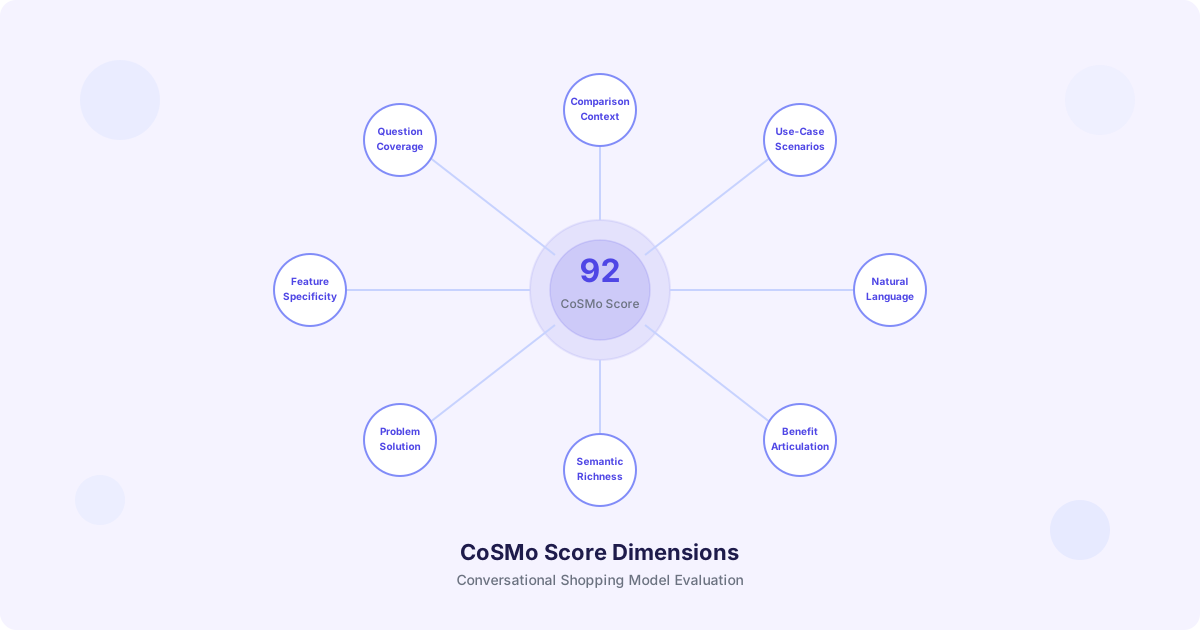
Based on extensive analysis of Rufus behavior and AI-mediated search patterns, we have identified eight key dimensions that CoSMo evaluates when scoring a listing’s conversational readiness.
1. Question Coverage
What it measures: How many common shopper questions your listing content can answer.
Shoppers do not just search for product names. They ask questions like “Does this work with induction cooktops?” or “Is this safe for toddlers?” Question coverage evaluates whether your listing content provides answers to the questions shoppers most frequently ask about products in your category.
How to improve:
- Research the questions shoppers ask in your category (check the “Customer Questions & Answers” section of competing products)
- Embed answers naturally in your bullet points and description
- Cover use-case questions (“Can I use this for…?”), compatibility questions (“Does this work with…?”), and specification questions (“How large is…?”)
- Address safety, material, and warranty questions proactively
Example: Instead of writing “Made from stainless steel,” write “Made from food-grade 304 stainless steel, safe for hot and cold beverages, dishwasher-safe on the top rack.”
2. Use-Case Scenarios
What it measures: Whether your listing describes realistic scenarios in which a customer would use your product.
CoSMo places high value on listings that help shoppers envision how a product fits into their daily life. When a shopper asks “What do I need for car camping with kids?”, listings that describe specific camping scenarios will score higher than those that simply list features.
How to improve:
- Describe 3-5 specific use cases in your bullet points
- Use phrases like “Perfect for…” or “Ideal when…” to trigger scenario matching
- Include seasonal and situational use cases (travel, everyday, gifting)
- Match use cases to the search queries your target customers actually use
Example: Instead of “Large capacity water bottle,” write “Large 32oz capacity — perfect for all-day hiking, keeping at your desk during work, or staying hydrated during gym sessions.”
3. Comparison Context
What it measures: Whether your listing helps shoppers compare your product against alternatives.
Shoppers frequently ask Rufus to compare products: “How does this compare to…” or “What is the difference between X and Y?” Listings that provide comparison context — even without naming competitors — enable CoSMo to position your product accurately in comparison conversations.
How to improve:
- Highlight what makes your product different from typical alternatives in the category
- Use comparative language: “Unlike standard models…” or “While most products in this category…”
- Quantify differences where possible (thicker material, longer battery, more capacity)
- Address the specific trade-offs shoppers consider in your category
Example: Instead of “Premium quality materials,” write “Double-wall vacuum insulation keeps drinks hot for 12 hours — twice the retention of single-wall alternatives.”
4. Feature Specificity
What it measures: How detailed and precise your feature descriptions are.
Vague descriptions score poorly on CoSMo. When a listing says “high quality” or “durable,” the AI has nothing concrete to work with. Feature specificity evaluates whether your listing provides measurable, verifiable details that an AI can confidently relay to a shopper.
How to improve:
- Replace every subjective adjective with a measurable fact
- Include dimensions, weights, capacities, and performance metrics
- Specify materials by grade or standard (e.g., “6061 aluminum” not just “aluminum”)
- Add compatibility details (model numbers, standards, certifications)
Example: Instead of “Powerful motor,” write “1,200-watt brushless motor delivering 25,000 RPM, 40% quieter than brushed alternatives at the same power output.”
5. Natural Language Flow
What it measures: Whether your listing content reads naturally when spoken aloud by an AI assistant.
CoSMo evaluates how well your content can be extracted and presented in a conversational format. Keyword-stuffed listings with awkward phrasing score poorly because the AI cannot naturally quote or paraphrase them when responding to shoppers.
How to improve:
- Read your bullet points aloud — if they sound awkward, rewrite them
- Avoid keyword stuffing (repeating the same keyword multiple times in one bullet)
- Use complete sentences where appropriate rather than telegram-style fragments
- Write as if explaining the product to a friend, then add keywords naturally
- Vary sentence structure across bullet points
Example: Instead of “Coffee mug travel mug insulated mug stainless steel mug hot cold mug,” write “This insulated travel mug keeps your coffee piping hot for up to 8 hours, making it the perfect companion for your morning commute or afternoon road trip.”
6. Problem-Solution Framing
What it measures: Whether your listing identifies problems your product solves and frames features as solutions.
Shoppers often approach Amazon with a problem to solve: “I need something to keep my lunch warm” or “My current phone case does not protect against drops.” CoSMo evaluates whether your listing content maps features to specific problems, enabling the AI to match your product to problem-oriented queries.
How to improve:
- Lead each bullet point with the problem or pain point it addresses
- Use the format: “Problem statement — how this product solves it”
- Address the top 3-5 frustrations customers have with competing products in your category
- Check negative reviews of competitors for common complaints your product addresses
Example: Instead of “Leak-proof lid with silicone seal,” write “Tired of spills in your bag? The triple-sealed silicone lid locks tight with a quarter-turn, tested leak-proof even when turned upside down.”
7. Benefit Articulation
What it measures: Whether your listing clearly communicates the tangible benefits of each feature.
Features describe what a product has. Benefits describe what a product does for the customer. CoSMo distinguishes between the two and places higher value on listings that articulate clear benefits because benefits directly answer the shopper’s implicit question: “Why should I buy this?”
How to improve:
- Apply the “So what?” test to every feature you list
- Connect each feature to a tangible outcome the shopper experiences
- Quantify benefits whenever possible (time saved, money saved, performance gained)
- Prioritize benefits that match the top purchase criteria in your category
Example: Instead of “Built-in LED light,” write “Built-in LED light lets you find what you need in your bag without fumbling in dark movie theaters, on evening flights, or during early morning commutes.”
8. Semantic Richness
What it measures: The vocabulary diversity and contextual depth of your listing content.
CoSMo evaluates the semantic richness of your listing — how varied and descriptive your language is. Listings that use a narrow vocabulary or repeat the same descriptors score lower than those that employ diverse, contextually relevant language. This dimension reflects the AI’s ability to match your product to a wider range of conversational queries.
How to improve:
- Use synonyms and related terms naturally throughout your content
- Include category-specific terminology that knowledgeable shoppers would recognize
- Describe textures, sensations, and experiences — not just specifications
- Vary descriptive language across bullet points rather than repeating the same phrases
- Include contextual vocabulary related to your product’s use environment
Example: Instead of repeating “comfortable” three times, use “ergonomic grip,” “cushioned handle,” and “balanced weight distribution” to describe different aspects of comfort.
How Peaklyst Measures Your CoSMo Score
Peaklyst calculates a CoSMo readiness score for every listing by evaluating each of the eight dimensions described above. The score is deterministic — the same listing content always produces the same score — and transparent, so you can see exactly which dimensions need improvement.
Each dimension receives a sub-score from 0 to 100. The overall CoSMo score is a weighted composite of all eight dimensions, designed to reflect how well your listing would perform in AI-mediated shopping interactions.
Our scoring methodology is based on linguistic analysis, not AI opinion. We examine sentence structure, vocabulary diversity, question-answer alignment, and scenario coverage using deterministic text analysis. This means your score is consistent, reproducible, and actionable.
You can see your CoSMo score in action by visiting the Rufus and CoSMo methodology guide or by running a free analysis on any ASIN with our Growth Plan Wizard.
Practical Steps to Improve Your CoSMo Score
Here is a practical checklist you can use right now to improve your listing’s CoSMo readiness:
Title Optimization for CoSMo
Your title is the first thing CoSMo evaluates. Make it count:
- Lead with the most specific product identifier (brand + product type)
- Include the primary use case in natural language
- Add key differentiating specifications (size, material, capacity)
- Avoid keyword repetition — each word should earn its place
Bullet Point Optimization for CoSMo
Bullet points are where CoSMo finds most of its conversational content:
- Start each bullet with a benefit or problem statement, not a feature
- Embed at least one realistic scenario per bullet point
- Include specific, measurable details (numbers, dimensions, certifications)
- Write in complete, natural sentences that an AI could quote directly
- Vary your vocabulary — do not repeat the same descriptors
Description Optimization for CoSMo
Your product description has more room for contextual depth:
- Tell a story about the problem your product solves
- Include comparison context (without naming competitors)
- Address frequently asked questions proactively
- Use paragraph format for natural language flow
- Add use-case scenarios that did not fit in bullet points
Backend Search Terms for CoSMo
While backend keywords are not directly visible to CoSMo, they influence which queries surface your listing, which in turn determines the conversational contexts in which CoSMo evaluates your content:
- Include question-format search terms where relevant
- Add synonym clusters for your key features and benefits
- Include problem-oriented terms shoppers might search for
- Use natural phrases rather than individual keyword fragments
CoSMo vs Traditional A10 Optimization
It is important to understand that CoSMo optimization is not a replacement for traditional keyword optimization — it is an evolution that builds on top of it.
| Aspect | A10 (Traditional) | CoSMo (Conversational) |
|---|---|---|
| Focus | Keyword presence | Question answerability |
| Content style | Keyword-dense | Naturally conversational |
| Success metric | Keyword rank position | AI recommendation rate |
| Optimization frequency | Quarterly | Continuous (4-8 week cycles) |
| Competitive advantage | Temporary (keywords are copyable) | Durable (quality is harder to replicate) |
The most effective listings excel at both. They contain comprehensive keyword coverage AND conversational, question-answering content. This dual optimization is exactly what the Growth System methodology is designed to achieve.
Common CoSMo Mistakes to Avoid
Even sellers who understand CoSMo make these common mistakes:
-
Over-indexing on one dimension. A listing with perfect feature specificity but no use-case scenarios will still score poorly overall. Balance matters.
-
Keyword stuffing in the name of “semantic richness.” Using obscure synonyms that no shopper would recognize does not help. Your vocabulary should be diverse but natural.
-
Writing for the AI instead of the shopper. CoSMo is designed to evaluate content that helps real shoppers. If your listing sounds like it was written for a machine, it will perform poorly with both humans and AI.
-
Optimizing once and forgetting. CoSMo evaluation evolves as Amazon updates its models. A listing that scores well today might need refreshing in 6-8 weeks. Build optimization into your regular routine.
-
Ignoring negative feedback signals. Customer questions, negative reviews, and return reasons often highlight the exact gaps in your CoSMo coverage. Mine these sources for improvement opportunities.
Getting Started with CoSMo Optimization
The gap between CoSMo-optimized and traditionally optimized listings is significant, and it is growing. As Amazon continues to expand Rufus and AI-mediated shopping, sellers who adapt their content strategy now will build a durable competitive advantage.
Here is how to get started:
- Score your current listings using the free Growth Plan Wizard — you will see your CoSMo score alongside traditional quality metrics
- Identify your weakest dimensions and focus improvement efforts there first
- Compare your listings to top competitors in your category on the comparison page
- Follow the Growth System methodology for structured 4-8 week optimization cycles that continuously improve your CoSMo readiness
CoSMo readiness is not a one-time project. It is an ongoing discipline that compounds over time. The sooner you start, the larger your advantage grows.