Visibility vs Conversion: Why Most Amazon Sellers Optimize Wrong
Learn why focusing only on keywords or only on compelling copy fails. The Growth System balances visibility and conversion optimization for sustainable Amazon growth.
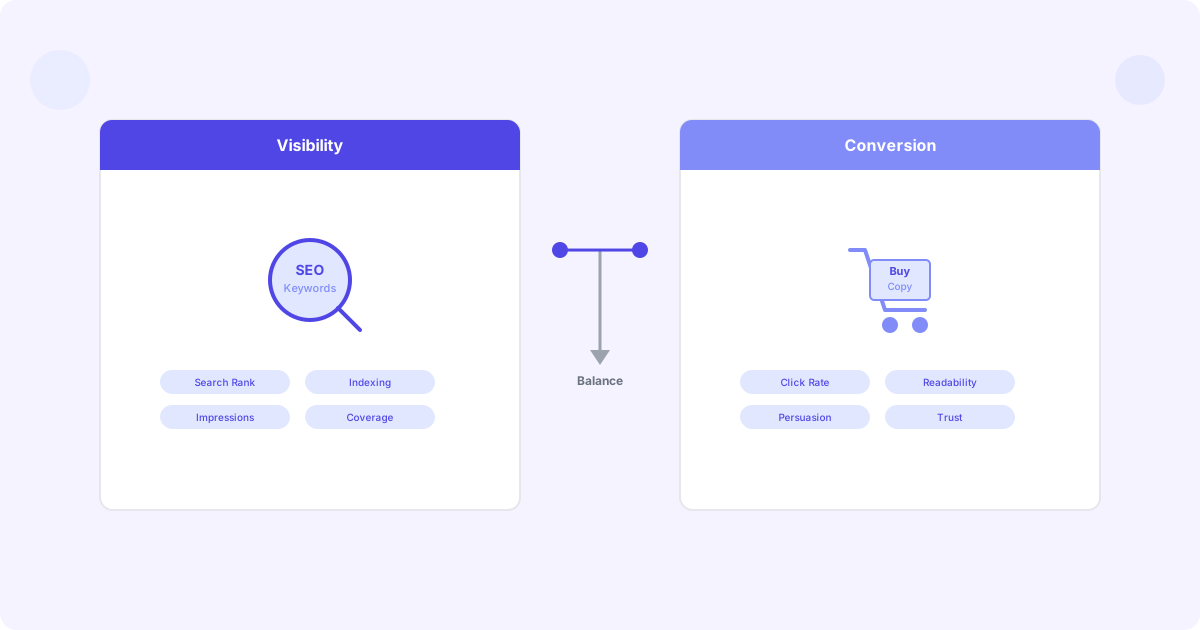
There are two types of Amazon sellers who struggle with listing optimization. The first type obsesses over keywords. They run reverse ASIN lookups, stuff every search term they can find into their listing, and chase ranking improvements. Their listings rank well — but shoppers land on the page and leave without buying.
The second type writes compelling, beautiful copy. Their bullet points tell a story. Their descriptions paint a picture. But no one finds the listing because it is invisible in search results. Great content that no one reads is wasted effort.
Both sellers are making the same fundamental mistake: they optimize for one side of the equation while ignoring the other. The Growth System addresses this by treating visibility and conversion as two distinct but equally important optimization objectives.
Understanding the Two Sides
Every Amazon listing serves two masters simultaneously. It must be discoverable by Amazon’s search algorithm, and it must be persuasive to the human being who lands on the page. These objectives sometimes conflict, and managing that tension is the core challenge of listing optimization.
Visibility Optimization
Visibility optimization is about getting your listing in front of shoppers. It covers everything that influences whether Amazon shows your product when someone searches for a relevant term.
The key dimensions of visibility optimization include:
- Keyword coverage — Containing the search terms that shoppers actually type into Amazon’s search bar. This includes primary keywords, long-tail variations, synonyms, and common misspellings.
- Search term indexing — Being recognized by Amazon’s algorithm as relevant for those keywords. Just having a keyword in your listing does not guarantee indexing; placement and context matter.
- Backend search terms — Leveraging the invisible 249-byte field for additional keyword coverage that does not clutter your visible content.
- Catalog attributes — Filling in product attributes (material, color, size, intended use) that Amazon uses for filtered searches and Browse Node navigation.
- Content completeness — Using all available character limits. Amazon’s algorithm favors listings that fully utilize the space provided.
Visibility optimization is measurable. You can track how many keywords you are indexed for, your rank positions, and how many impressions your listing receives. It is also relatively mechanical — there are clear best practices and tools to identify gaps.
Conversion Optimization
Conversion optimization is about turning visitors into buyers. Once a shopper lands on your listing, the content must answer their questions, overcome objections, and motivate a purchase.
The key dimensions of conversion optimization include:
- Readability — Can the shopper quickly scan and understand what the product is and why it matters? Short sentences, clear formatting, and logical hierarchy are essential.
- Persuasion — Does the copy translate features into benefits? Does it address pain points? Is there a clear value proposition that differentiates from competitors?
- Trust signals — Does the listing build confidence? Specific numbers, material details, warranty information, and use-case scenarios all contribute to trust.
- Semantic richness — Does the content provide enough context for shoppers who are comparing products? Can Amazon’s AI assistant Rufus extract meaningful answers from your listing?
- Image-text alignment — Does the text complement the images? Shoppers process listings holistically — disconnects between visual and written content hurt conversion.
Conversion optimization is harder to measure directly. You can track your listing’s conversion rate (unit session percentage), but many factors outside your listing content affect that number (price, reviews, competition, seasonality). Still, well-optimized content consistently outperforms poorly written alternatives.
The Keyword-Stuffing Trap
The most common optimization mistake is over-indexing on visibility at the expense of conversion. This usually manifests as keyword stuffing — cramming as many search terms as possible into the visible listing content.
Here is what keyword-stuffed content typically looks like:
“Premium Wireless Bluetooth Earbuds Headphones with Noise Cancelling ANC True Wireless in-Ear Earphones with Microphone Mic for Running Gym Workout Sport Fitness Exercise with Charging Case USB-C Compatible iPhone Android Samsung Galaxy”
This title hits dozens of keywords. From a visibility standpoint, it checks many boxes. But from a conversion standpoint, it is nearly unreadable. A shopper scanning this title gets no clear sense of what makes this product different from the hundreds of other wireless earbuds on the page.
Compare it with a balanced approach:
“ProSound AX-7 Wireless Earbuds — Active Noise Cancelling with 40-Hour Battery | IPX7 Waterproof for Running and Gym | USB-C Fast Charge”
This title contains strong primary keywords (wireless earbuds, noise cancelling, waterproof, running) while also communicating specific differentiators (brand name, model, 40-hour battery, IPX7 rating, USB-C). A shopper can immediately understand what this product is and why it might be worth clicking.
The difference in click-through rate between these two approaches is significant. And click-through rate is itself a ranking factor in Amazon’s A10 algorithm — meaning better conversion-oriented content can actually improve your visibility too.
The Beautiful-Copy Trap
The opposite mistake is less common but equally damaging. Some sellers, often with marketing backgrounds, write beautifully crafted copy that reads like magazine advertising. The problem is that it does not contain the keywords shoppers search for.
Consider this bullet point:
“Experience audio perfection. Our engineers spent three years crafting a sound signature that brings your music to life with stunning clarity and depth.”
It is well-written. It is evocative. But it contains zero searchable keywords. A shopper searching for “noise cancelling earbuds for gym” will never find this listing. The copy is excellent at converting visitors who somehow discover the product, but the discovery rate is minimal.
A balanced version maintains the persuasive quality while incorporating search-relevant terms:
“Active Noise Cancelling Technology — Our engineers spent three years perfecting the ANC system that blocks up to 98% of ambient noise. Hear your music with stunning clarity at the gym, on flights, or during your commute.”
This version includes important keywords (active noise cancelling, ANC, gym, flights, commute) while retaining the persuasive narrative structure. It serves both the algorithm and the human reader.
How the Growth System Balances Both
The Growth System’s eight quality dimensions are deliberately split between visibility and conversion concerns. This structural balance prevents you from over-optimizing in one direction.
Visibility-Focused Dimensions
- Keyword Coverage — Measures search term inclusion and distribution
- Content Completeness — Measures utilization of available space
- Backend Optimization — Measures hidden field usage
- Compliance — Measures adherence to Amazon’s formatting rules (which affect indexing)
Conversion-Focused Dimensions
- Readability — Measures ease of scanning and comprehension
- Persuasion — Measures benefit-driven language and value propositions
- Semantic Richness — Measures contextual depth for AI and comparison shoppers
- Image Quality — Measures visual impact and technical standards
When you score a listing, you get sub-scores for each dimension. If your visibility dimensions score 85 but your conversion dimensions score 55, the system immediately surfaces the imbalance. You know to focus on readability and persuasion rather than adding more keywords.
This balance check is something most sellers never do. They either check their keyword coverage (visibility) or read their listing subjectively (conversion) but rarely evaluate both systematically.
Real-World Examples
Example 1: The Keyword-Heavy Listing
A seller of stainless steel water bottles had a listing packed with keywords. The title was 195 characters of search terms. All five bullet points started with keywords in uppercase. The description was essentially a keyword list formatted as sentences.
Scores:
- Keyword Coverage: 91
- Content Completeness: 88
- Readability: 38
- Persuasion: 42
- Composite: 64
The listing ranked on page 1 for dozens of keywords but converted at only 6.2% — well below the category average of 11%. Shoppers were finding the product but choosing competitors with more compelling copy.
After rebalancing: The seller rewrote bullet points to lead with benefits, shortened sentences, and added specific differentiating details (capacity, weight, insulation hours). Keywords were redistributed so each bullet point served both search and persuasion purposes.
New scores:
- Keyword Coverage: 83 (slight drop, expected)
- Readability: 74
- Persuasion: 71
- Composite: 78
Conversion rate rose to 13.8%. Despite ranking for fewer keywords, total revenue increased by 31% because far more visitors became buyers.
Example 2: The Marketing-Copy Listing
A seller of premium yoga mats had elegant, brand-focused copy. The listing read beautifully but lacked search-relevant terms. The title mentioned only the brand name and a poetic tagline.
Scores:
- Keyword Coverage: 34
- Readability: 89
- Persuasion: 82
- Composite: 58
The listing converted visitors at 18% — excellent for the category. But it received only 40 sessions per day because it ranked for almost no relevant search terms.
After rebalancing: The seller added strategic keywords to the title (yoga mat, non-slip, extra thick, eco-friendly) and incorporated search terms naturally throughout the bullet points. The brand voice was preserved, but each section now included relevant keywords woven into the persuasive copy.
New scores:
- Keyword Coverage: 76
- Readability: 84 (minor drop from added terms)
- Persuasion: 79
- Composite: 80
Sessions increased to 290 per day. Conversion rate dipped slightly to 15.4%, which is expected when reaching a broader audience. But total daily revenue tripled.
Example 3: The Balanced Listing
A top-performing seller of kitchen scales maintained a listing that scored above 70 on every dimension. No single area was a standout, but no area was a weakness either.
Scores:
- Keyword Coverage: 78
- Content Completeness: 81
- Readability: 75
- Persuasion: 73
- Semantic Richness: 72
- Composite: 76
This seller ran weekly optimization cycles, incrementally improving the weakest dimension each week. Over eight weeks:
- Week 1-2: Improved semantic richness by adding use-case scenarios (72 to 81)
- Week 3-4: Enhanced readability with shorter sentences and better formatting (75 to 83)
- Week 5-6: Expanded keyword coverage with newly trending search terms (78 to 84)
- Week 7-8: Strengthened persuasion with customer-derived benefit statements (73 to 82)
Final composite: 83. Revenue grew 22% over the eight-week period with no changes to price, advertising, or inventory.
Practical Framework: The Visibility-Conversion Audit
You can apply this balanced approach to your own listings with a structured audit. For each listing, evaluate these five areas:
1. Title Balance Check
Read your title as a shopper first. Can you understand in three seconds what the product is and why it is worth clicking? Then check it as a keyword researcher. Does it contain your 2-3 most important search terms?
If you can answer yes to both questions, your title is balanced.
2. Bullet Point Distribution
Assign each bullet point a primary purpose: is it mainly serving visibility (keyword inclusion) or conversion (benefit communication)? Ideally, each bullet point serves both — leading with a benefit and incorporating keywords naturally.
If all five bullet points are keyword-heavy, your conversion will suffer. If all five are benefit-focused without keywords, your visibility will suffer.
3. Description Strategy
The description is your most flexible content area. Use it for long-tail keywords, use-case scenarios, and storytelling that builds trust. This is where you can load keywords without sacrificing readability because shoppers who read the description are already engaged.
4. Backend as Safety Net
Your backend search terms should contain everything that did not fit naturally into your visible content. Common misspellings, synonym variations, Spanish language terms, and long-tail phrases all belong here. This frees your visible content to focus on readability and persuasion.
5. Score and Compare
Use the Peaklyst Quality Score or your own evaluation criteria to score each listing across both visibility and conversion dimensions. The goal is not to maximize either side individually — it is to maintain a balanced score above 70 across all dimensions.
The Visibility-Conversion Sweet Spot
The most important takeaway is that visibility and conversion are not opposing forces. They can and should reinforce each other. When done well:
- Keywords appear naturally within benefit-driven sentences
- High readability improves dwell time, which signals relevance to the algorithm
- Specific product details serve both as search terms and trust builders
- Semantic richness satisfies both AI assistants and human comparison shoppers
The Growth System’s balanced scoring framework makes this sweet spot visible and measurable. Instead of guessing whether your listing leans too far in one direction, you can see the scores and course-correct.
For a deeper dive into how visibility and conversion work together, visit the Visibility vs Conversion methodology page. To see where your own listings stand, try the free Growth Plan Wizard and get instant scores across all dimensions.