How to Build a Growth Plan for Your Amazon Product Portfolio
Learn how to create a data-driven growth plan that prioritizes your highest-impact Amazon listings and allocates optimization effort where it matters most.
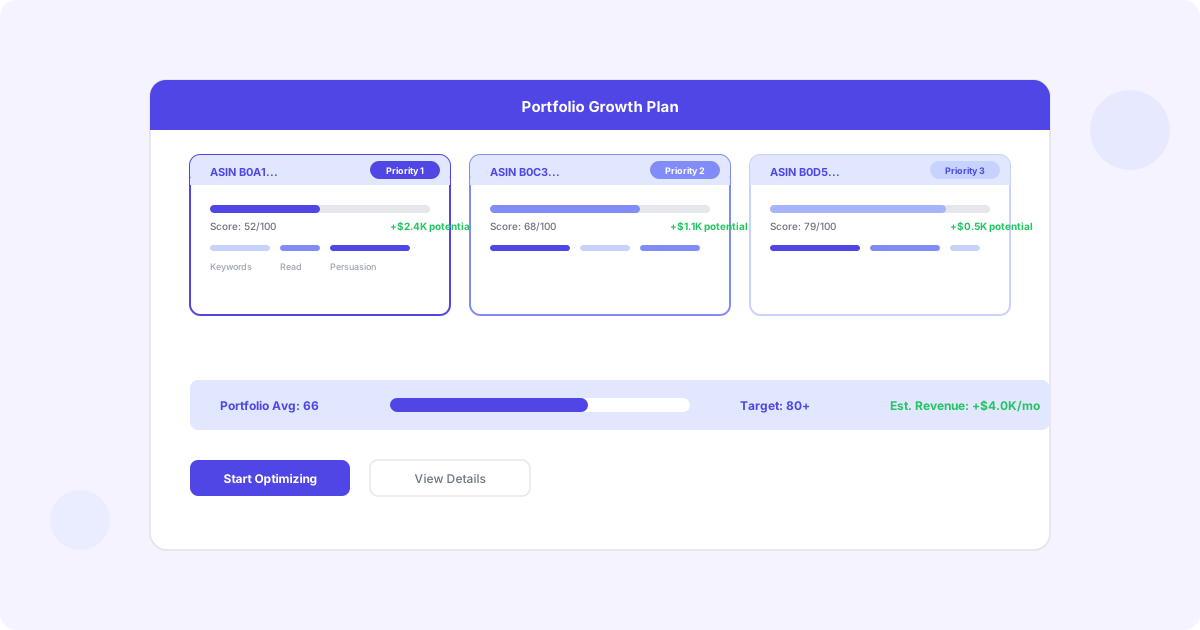
Most Amazon sellers optimize their listings one at a time, starting with whichever product comes to mind first. This approach wastes effort on low-impact work while high-potential listings sit neglected. A growth plan fixes this by systematically identifying which listings deserve attention, in what order, and with what type of optimization.
In this guide, we walk through how to build a data-driven growth plan for your Amazon product portfolio — whether you sell five products or five hundred.
Why You Need a Portfolio-Level Strategy
Individual listing optimization is important. But without a portfolio-level view, you cannot answer the most critical strategic questions:
- Which listing should I optimize first? The answer is not always your best seller or your worst performer. It is the listing with the highest gap between its current performance and its potential.
- Where should I allocate my time? An hour spent improving a $10,000/month listing with a Quality Score of 50 produces far more revenue than the same hour spent on a $200/month listing with the same score.
- What type of optimization matters most? Your portfolio might have a systemic problem — maybe all your listings have weak readability scores. Fixing this across the board is more efficient than optimizing one listing at a time on different dimensions.
- Am I actually making progress? Without portfolio-level tracking, you cannot see whether your overall listing quality is improving or if gains in one area are offset by regression elsewhere.
A growth plan answers these questions with data instead of intuition.
Step 1: Audit Your Entire Portfolio
The first step is establishing a comprehensive baseline. Score every active listing across all eight quality dimensions:
- Keyword Coverage
- Content Completeness
- Readability
- Persuasion
- Compliance
- Image Quality
- Backend Optimization
- Semantic Richness
For each listing, also record current business metrics:
- Monthly revenue — How much does this listing generate?
- Monthly sessions — How much traffic does it receive?
- Conversion rate — What percentage of visitors purchase?
- BSR (Best Seller Rank) — How does it rank in its category?
- Review count and rating — What is the current social proof position?
This audit gives you a complete picture of your portfolio’s health. It takes time upfront but saves weeks of misdirected effort downstream.
What the Audit Reveals
Most sellers are surprised by what their portfolio audit shows. Common patterns include:
The Hidden Gem: A listing generating modest revenue ($500-1,000/month) with a very low Quality Score (40-55). This product has demand — people are buying despite poor content. Improving the listing could double or triple revenue with minimal effort.
The Over-Performer: A listing with a high Quality Score (80+) that generates disproportionate revenue. This listing does not need optimization — it needs protection. Monitor it for regression but do not tinker with what works.
The Traffic Leak: A listing with high sessions but low conversion rate. The product is discoverable, but shoppers are not buying. This indicates a conversion optimization problem — readability, persuasion, or image quality needs attention.
The Invisible Listing: A listing with a decent conversion rate but almost no traffic. The product converts well when found, but it is not showing up in search results. This needs keyword coverage and backend optimization.
Step 2: Calculate Impact Potential
Not every Quality Score point is created equal. A listing jumping from 50 to 70 will see a much larger business impact than one jumping from 75 to 85. And a high-revenue listing’s improvement matters more than a low-revenue listing’s improvement.
The Impact Matrix
Plot your listings on two axes:
X-axis: Revenue (low to high) Y-axis: Quality Score gap (distance from 80, your target)
Listings that land in the top-right quadrant — high revenue and large quality gap — are your highest-impact optimization targets.
Revenue-Weighted Priority Score
For a more precise prioritization, calculate a priority score for each listing:
Priority Score = Monthly Revenue x (80 - Current Quality Score) / 80
This formula produces higher scores for listings that combine high revenue with large improvement potential. Examples:
| Listing | Revenue | Quality Score | Priority Score |
|---|---|---|---|
| ASIN A | $8,000/mo | 52 | $3,500 |
| ASIN B | $2,000/mo | 45 | $875 |
| ASIN C | $12,000/mo | 73 | $1,050 |
| ASIN D | $500/mo | 38 | $263 |
| ASIN E | $6,000/mo | 81 | -$75 (skip) |
ASIN A has the highest priority despite not having the highest revenue or the lowest quality score. ASIN E scores negative, meaning it is already above the target threshold and should be in maintenance mode.
Step 3: Identify Systemic Patterns
Before diving into individual listings, look for patterns across your portfolio. These systemic issues are often the most efficient to fix because a single improvement applies to many listings.
Common Systemic Patterns
Low readability across the board: This usually means your listings were written (or generated) with a keyword-first approach. The fix is a readability pass across all listings, reformatting sentences, adding structure, and improving scannability.
Weak backend optimization everywhere: Many sellers fill in backend search terms once at launch and never revisit them. A systematic backend audit can improve keyword coverage across your entire portfolio in a single session.
Missing semantic richness: If none of your listings include use-case scenarios, comparison context, or Q&A-style content, adding this dimension systematically gives you an advantage as AI shopping assistants like Rufus become more important.
Compliance issues: A consistent compliance problem (like using superlatives or making unsupported claims) often reflects a writing habit that appears across all listings. Fix the pattern once and prevent it going forward.
Portfolio-Level Dimension Analysis
Calculate the average score for each dimension across your portfolio:
| Dimension | Portfolio Average | Target | Gap |
|---|---|---|---|
| Keyword Coverage | 71 | 80 | 9 |
| Content Completeness | 74 | 80 | 6 |
| Readability | 52 | 80 | 28 |
| Persuasion | 58 | 80 | 22 |
| Compliance | 83 | 80 | 0 |
| Image Quality | 69 | 80 | 11 |
| Backend Optimization | 55 | 80 | 25 |
| Semantic Richness | 47 | 80 | 33 |
In this example, Semantic Richness (33-point gap) and Readability (28-point gap) are systemic weaknesses. These dimensions should be addressed across the portfolio before diving into listing-specific optimization.
Step 4: Create Your Optimization Roadmap
With priority scores calculated and systemic patterns identified, you can build a concrete roadmap:
Phase 1: Quick Wins (Week 1-2)
Start with optimizations that are high impact and low effort:
- Backend optimization audit across all listings (1-2 hours)
- Compliance fixes on any flagged listings (30 minutes per listing)
- Content completeness — fill any empty fields (15 minutes per listing)
These changes require minimal creative effort and often produce immediate indexing improvements.
Phase 2: Systemic Fixes (Week 3-6)
Address the portfolio-wide dimension weaknesses:
- If readability is the systemic weakness, rewrite bullet points across your top-priority listings with shorter sentences, benefit-first structure, and improved formatting
- If semantic richness is the systemic weakness, add use-case scenarios and comparison context to all top-priority listings
Work through listings in priority order (highest priority score first).
Phase 3: Deep Optimization (Week 7-12)
Now tackle listing-specific issues. For each listing in priority order:
- Identify its unique weakest dimension (after systemic fixes)
- Make targeted improvements
- Measure the impact over the following week
- Move to the next listing
Phase 4: Maintenance (Ongoing)
Once your portfolio reaches an average Quality Score of 75+:
- Monitor for regression weekly
- Re-run the full audit monthly
- Address any listing that drops below 70 in any dimension
- Stay current with marketplace changes (new search terms, competitor updates, algorithm shifts)
Step 5: Track Portfolio-Level Metrics
A growth plan is only as good as its measurement system. Track these portfolio-level metrics weekly:
Portfolio Quality Score
The average Quality Score across all active listings. This is your headline metric. Track it weekly and expect steady improvement if you are following your roadmap.
Good trajectory: 2-4 point average improvement per month during active optimization. Slower gains (0.5-1 point) during maintenance.
Revenue per Quality Point
Calculate the total portfolio revenue divided by the average Quality Score. This ratio shows how efficiently your listings convert their quality into revenue. A rising ratio means your optimization effort is translating into business results.
Dimension Distribution
Track the spread of scores within each dimension. A portfolio where readability ranges from 30 to 90 has a consistency problem. The goal is tight distribution above 70 across all dimensions.
Regression Rate
How many listings dropped in score this week without any intentional changes? A high regression rate means external factors (competitors, algorithm changes) are eroding your gains faster than you are making them. This signals a need to increase your optimization cadence.
The Growth Wizard Shortcut
If building a growth plan from scratch feels overwhelming, Peaklyst’s Growth Plan Wizard automates the entire process:
- Enter any ASIN and get an instant Quality Score breakdown across all eight dimensions
- See your weakest dimensions highlighted with specific improvement suggestions
- Get priority recommendations based on your portfolio’s revenue and quality gaps
- Track progress automatically as you implement changes through the platform
The wizard is free for any ASIN — no account required. It gives you an immediate view of where your listings stand and what to improve first.
For sellers with larger portfolios, the full Peaklyst platform provides automated scoring across all listings, portfolio-level dashboards, AI-generated optimization suggestions, and one-click publishing to Amazon. The Growth System methodology overview explains the complete framework in detail.
Common Growth Plan Mistakes
Mistake 1: Starting with Your Best Seller
Your best-selling listing is often already well-optimized (that is why it sells well). The highest ROI usually comes from mid-tier listings with clear optimization gaps — they have proven demand but underperforming content.
Mistake 2: Trying to Optimize Everything at Once
Spreading effort across 50 listings simultaneously means no listing gets enough attention to move the needle. Focus on 3-5 priority listings at a time.
Mistake 3: Ignoring Maintenance
Once you reach your target scores, the work is not done. The marketplace changes constantly. Budget 20% of your optimization time for maintenance and regression checks.
Mistake 4: Optimizing by Gut
“I think this listing needs better bullet points” is a guess. “This listing scores 42 on readability because sentences average 38 words” is a diagnosis. Always start with the data.
Mistake 5: Not Measuring Revenue Impact
Quality Scores are a means to an end. If scores improve but revenue does not, something else is wrong (pricing, reviews, competition, or your scoring model does not match market reality). Always tie optimization work back to revenue outcomes.
Getting Started Today
Building a growth plan does not require a massive upfront investment. Start with these three actions:
- Score your top 5 revenue-generating listings using the free Growth Plan Wizard
- Identify the weakest dimension across those five listings
- Make one targeted improvement to your highest-priority listing this week
From there, expand the plan as you see results. The data-driven approach compounds over time — each cycle’s improvement builds on the last, and portfolio-level patterns become clearer as you accumulate more data points.
The sellers who build and follow a growth plan consistently outperform those who optimize reactively. The difference is not talent or budget — it is systematic prioritization of high-impact work.